Development of Muslim Theology, Jurisprudence, and Constitutional Theory — John Shaqi
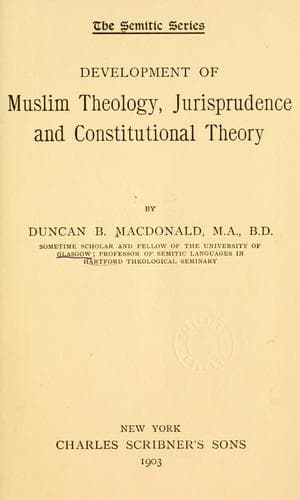
Development of Muslim Theology, Jurisprudence, and Constitutional TheoryMacDonald, Duncan Black
ReligionIslamic
Development of Muslim Theology, Jurisprudence, and Constitutional Theory
MacDonald, Duncan Black
Constitutional law (Islamic law); Islam -- Doctrines -- History; Islam and state -- History; Islamic law -- History
It cannot be doubted that these men were the true representatives of
the old Islam. They claimed for themselves the heirship to Abu Bakr and
Umar, and their claim was just. Islam had been secularized; worldly
ambition, fratricidal strife, luxury, and sin had destroyed the old bond
of brotherhood. So they drew themselves apart and went their own way, a
way which their descendants still follow in Uman, in east Africa, and in
Algeria. To them the orthodox Muslims—meaning by that the general body
of Muslims—were antipathetic more than even Christians or Jews. These
were “people of a book” (_ahl kitab_), i.e., followers of a revealed
religion, and kindly treatment of them was commanded in the Qur’an. They
had never embraced Islam, and were to be judged and treated on their own
merits. The non-Kharijite Muslims, on the other hand, were renegades
(_murtadds_) and were to be killed at sight. It is easy to understand
to what such a view as this led. Numberless revolts, assassinations,
plunderings marked their history. Crushed to the ground again and again,
again and again they recovered. They were Arabs of the desert; and the
desert was always there as a refuge. It is probable, but as yet unproved,
that mingled with the political reasons for their existence as a sect
went tribal jealousies and frictions; of such there have ever been enough
and to spare in Arabia. Naturally, under varying conditions, their
views and attitudes varied. In the wild mountains of Khuzistan, one of
their centres and strongholds, the primitive barbarism of their faith
had full sway. It drew its legitimate consequence, lived out its life,
and vanished from the scene. The more moderate section of the Kharijites
centred round al-Basra. Their leader there was Abd Allah ibn Ibad, and
from about the year 60 on the schism between his followers and the more
absolute of these “come-outers” can be traced. It is characteristic of
the latter that they aided for a time Abd Allah ibn az-Zubayr when he was
besieged in Mecca by the Umayyads, but deserted him finally because he
refused to join the names of Talha and his own father, az-Zubayr, with
those of Uthman and Ali in a general commination. The Kharijites were
all good at cursing, and the later history of this section of them shows
a process of disintegration by successive secessions, each departing
in protest and cursing those left behind as heathen and unbelievers.
Characteristic, too, for the difference between the two sections, were
their respective attitudes toward the children of their opponents. The
more absolute party held that the children of unbelievers were to be
killed with their parents; the followers of Abd Allah ibn Ibad, that they
were to be allowed to grow up and then given their choice. Again, there
was a difference of opinion as to the standing of those who held with the
Kharijites but remained at home and did not actually fight in the Path of
God. These the one party rejected and the other accepted. Again, were
Public-domain text, read in full here on John Shaqi.
Reviews
Reviews
No reviews yet
Be the first to share your thoughts on this work.
Join the Discussion
Join the discussion
Sign in to leave a comment or review.
Sign InorCreate an account