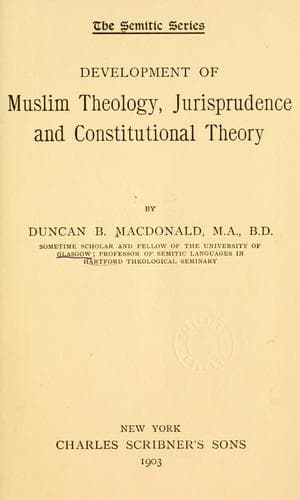
Development of Muslim Theology, Jurisprudence, and Constitutional TheoryMacDonald, Duncan Black
ReligionIslamic
Development of Muslim Theology, Jurisprudence, and Constitutional Theory
MacDonald, Duncan Black
Constitutional law (Islamic law); Islam -- Doctrines -- History; Islam and state -- History; Islamic law -- History
The Umayyads themselves clearly recognized that with their accession
to power a change had come in the nature of the Muslim state. Mu‘awiya
said openly that he was the first king in Islam, though he retained and
used officially the title of Khalifa and Commander of the Faithful. Yet
such a change could not be complete nor could it carry with it the whole
people—that is clear of itself. For more than one hundred years the house
of Umayya held its own. Syria was solid with it and it was supported by
many statesmen and soldiers; but outside of Syria and north Arabia it
could count on no part of the population. An anti-Khalifa, Abd Allah,
son of the az-Zubayr of whom we have already heard, long held the sacred
cities against them. Only in A.H. 75 (A.D. 692) was he killed after
Mecca had been stormed and taken by their armies. Southern Arabia and
Mesopotamia, with its camp-cities al-Kufa and al-Basra, Persia and Egypt,
were, from time to time, more or less in revolt. These risings went in
one or other of two directions. There were two great anti-Umayyad sects.
At one time in Mu‘awiya’s contest with Ali, he trapped Ali into the
fatal step of arbitrating his claim to the Khalifate. It was fatal, for
by it Ali alienated some of his own party and gained less than nothing
on the other side. Part of Ali’s army seceded in protest and rebellion,
because he—the duly elected Khalifa—submitted his claim to any shadow
of doubt. On the other hand, they could not accept Mu‘awiya, for him
they regarded as unduly elected and a mere usurper. Thus they drifted
and split into innumerable sub-sects. They were called Kharijites—goers
out—because they went out from among the other Muslims, refused to regard
them as Muslims and held themselves apart. For centuries they continued
a thorn in the side of all established authority. Their principles were
absolutely democratic. Their idea of the Khalifate was the old one of the
time of Abu Bakr and Umar. The Khalifa was to be elected by the whole
Muslim community and could be deposed again at need. He need be of no
special family or tribe; he might be a slave, provided he was a good
Muslim ruler. Some admitted that a woman might be Khalifa, and others
denied the need of any Khalifa at all; the Muslim congregation could rule
itself. Their religious views were of a similarly unyielding and antique
cast, but with that we have nothing now to do.
[Sidenote: IBADITES]
Public-domain text, read in full here on John Shaqi.
Reviews
Reviews
No reviews yet
Be the first to share your thoughts on this work.
Join the Discussion
Join the discussion
Sign in to leave a comment or review.
Sign InorCreate an account