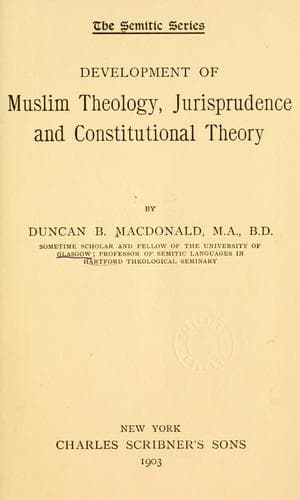
Development of Muslim Theology, Jurisprudence, and Constitutional TheoryMacDonald, Duncan Black
ReligionIslamic
Development of Muslim Theology, Jurisprudence, and Constitutional Theory
MacDonald, Duncan Black
Constitutional law (Islamic law); Islam -- Doctrines -- History; Islam and state -- History; Islamic law -- History
Like his predecessors, Abd ar-Razzaq divides men into classes according
to their insight into divine things. The first is of men of the world,
who are ruled by the flesh (_nafs_) and who live careless of all
religion. The second is of men of reason (_aql_). They through the reason
contemplate God, but see only His external attributes. The third is of
men of the spirit (_ruh_) who, in ecstasy, see God face to face in His
very essence, which is the substrate of all creation.
In his cosmogony, Abd ar-Razzaq follows, of course, the neo-Platonic
model and shows great ingenuity in weaving into it the crude and
materialistic phrases and ideas of the Qur’an. Like all Muslim thinkers
he displays an anxiety to square with his philosophy the terms dear to
the multitude.
[Sidenote: IBN TAYMIYA]
To Ibn Taymiya all this was the very abomination of desolation itself.
He had no use for mystics, philosophers, Ash‘arite theologians, or, in
fact, for anyone except himself. A contemporary described him as a man
most able and learned in many sciences, but with a screw loose. However
it may have been about the last point, there can be no question that
he was the reviver for his time and the transmitter to our time of the
genuine Hanbalite tradition, and that his work rendered possible the
Wahhabites and the Brotherhood of as-Sanusi. He was the champion of the
religion of the multitude as opposed to that of the educated few with
which we have been dealing so long. This popular theology had been going
steadily upon its way and producing its regular riots and disputings. It
is related of a certain Ash‘arite doctor, Fakhr ad-Din ibn Asakir (d.
620), that, in Damascus, he never dared to pass by a certain way through
fear of Hanbalite violence. The same Fakhr ad-Din once gave, as in duty
bound, the normal salutation of the Peace to a Hanbalite theologian. The
Hanbalite did not return it, which was more than a breach of courtesy,
and indicated that he did not regard Fakhr ad-Din as a Muslim. When
people remonstrated with him, he turned it as a theological jest and
replied, “That man believes in ‘Speech in the Mind’ (_kalam nafsi,
hadith fi-n-nafs_), so I returned his salutation mentally.” The point
is a hit at the Ash‘arites, who contended that thought was a kind of
speech without letters or sounds, and that God’s quality of Speech could
therefore be without letters or sounds.
Public-domain text, read in full here on John Shaqi.
Reviews
Reviews
No reviews yet
Be the first to share your thoughts on this work.
Elsewhere in the archive
Join the Discussion
Join the discussion
Sign in to leave a comment or review.
Sign InorCreate an account