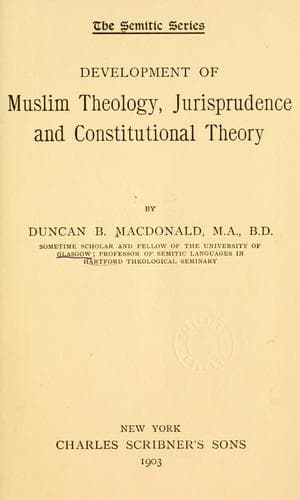
Development of Muslim Theology, Jurisprudence, and Constitutional TheoryMacDonald, Duncan Black
ReligionIslamic
Development of Muslim Theology, Jurisprudence, and Constitutional Theory
MacDonald, Duncan Black
Constitutional law (Islamic law); Islam -- Doctrines -- History; Islam and state -- History; Islamic law -- History
But even the simple orthodoxy of the populace had not remained unchanged.
It had received a vast accretion of the most multifarious superstitions.
The cult of saints, alive and dead, of holy sites, trees, garments, and
the observance of all manner of days and seasons had been developing
parallel to the advance of Sufiism among the educated. The _walis_ were
untiring in the recital of the _karamat_ which God had worked for them,
and the populace drank in the wonders greedily. The metaphysical and
theological side they left untouched. “This is a holy man,” they said,
“who can work miracles; we must fear and serve him.” And so they would do
without much thought whether his morality might not be antinomian and his
theology pantheistic. To abate this and other evils and bring back the
faith of the fathers was the task which Ibn Taymiya took up.
[Sidenote: A MUJTAHID]
He was born near Damascus in 661 and educated as a Hanbalite. His
family had been Hanbalite for generations, and he himself taught in
that school and was reckoned as the greatest Hanbalite of his time.
His position, too, was practically that of Ahmad ibn Hanbal, modified
by the necessities imposed by new controversaries. Thus he was an
anthropomorphist, but of what exact shade is obscure. He was accused of
teaching that God was above His throne, could be pointed at, and that He
descended from His seat as a man might, _i.e._, that He was in space. But
he certainly distinguished himself from the crasser materialists. He
refused to be classed as the adherent of any school or of any system save
that of Muhammad and the agreement of the fathers. He claimed for himself
the rights of a _mujtahid_ and went back to first sources and principles
in everything. His self-confidence was extreme, and he smote down with
proud words the Rightly Guided Khalifas, Umar and Ali, themselves. His
bases were Qur’an, tradition from the Prophet and from the Companions and
analogy. Agreement, in the broad sense of the agreement of the Muslim
people, he rejected. If he had accepted it he would have been forced
to accept innumerable superstitions, beliefs, and practices—especially
the whole doctrine of the _walis_ and their wonders—for their basis
was agreement. The agreement of the Companions he did accept, while
convicting them right and left of error as individuals.
Public-domain text, read in full here on John Shaqi.
Reviews
Reviews
No reviews yet
Be the first to share your thoughts on this work.
Elsewhere in the archive
Join the Discussion
Join the discussion
Sign in to leave a comment or review.
Sign InorCreate an account