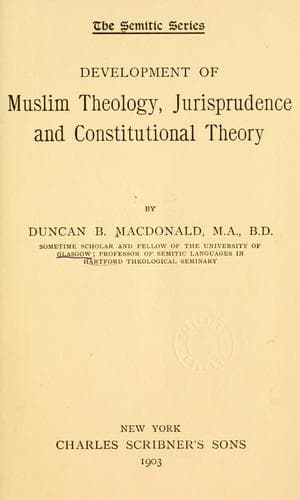
Development of Muslim Theology, Jurisprudence, and Constitutional TheoryMacDonald, Duncan Black
ReligionIslamic
Development of Muslim Theology, Jurisprudence, and Constitutional Theory
MacDonald, Duncan Black
Constitutional law (Islamic law); Islam -- Doctrines -- History; Islam and state -- History; Islamic law -- History
His life was filled up with persecutions and misfortune. He was a popular
idol, and inquiries for his judgment on theological and canonical
questions kept pouring in upon him. If there was no inquiry, and he
felt that a situation called for an expression of opinion from him, he
did not hesitate to send it out with all formality. It is true that it
is the duty of every Muslim, so far as he can, to do away or at least
to denounce any illegality or unorthodox view or practice which he may
observe. This duty evidently weighed heavily on Ibn Taymiya, and there
was fear at one time at the Mamluk court lest he might go the way of
Ibn Tumart. In one of these utterances he defined the doctrine of God’s
qualities as Ibn Hazm had done, and joined thereto denunciations of
the Ash‘arite kalam and of the Qur’anic exegesis of the mutakallims as
a whole. They were nothing but the heirs and scholars of philosophers,
idolaters, Magians, etc.; and yet they dared to go beyond the Prophet
and his heirs and Companions. The consequence of this _fatwa_ or legal
opinion was that he was silenced for a time as a teacher. On another
occasion he gave out a _fatwa_ on divorce, pronouncing _tahlil_ illegal.
_Tahlil_ is a device by which an awkward section in the canon law is
evaded. If a man divorces his wife three times, or pronounces a threefold
divorce formula, he cannot remarry her until she has been married to
another man, has cohabited with him and been divorced by him. Muslim
ideas of sexual purity are essentially different from ours, and the
custom has grown up, when a man has thus divorced his wife in hasty
anger, of employing another to marry her on pledge of divorcing her
again next day. Sometimes the man so employed refuses to carry out his
contract; such refusal is a frequent _motif_ in oriental tales. To avoid
this, the husband not infrequently employs one of his slaves and then
presents him to his former wife the next day. A slave can legally marry a
free woman, but when he becomes her property the marriage is _ipso facto_
annulled, because a slave cannot be the husband of his mistress or a
slave woman the wife of her master. It is to Ibn Taymiya’s credit that he
was one of the few to lift up their voices against this abomination. His
independence is shown at its best.
[Sidenote: CONTROVERSY WITH SUFIS]
Public-domain text, read in full here on John Shaqi.
Reviews
Reviews
No reviews yet
Be the first to share your thoughts on this work.
Elsewhere in the archive
Join the Discussion
Join the discussion
Sign in to leave a comment or review.
Sign InorCreate an account