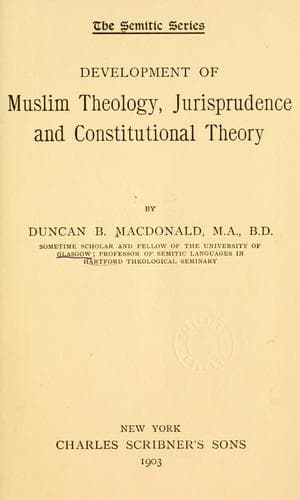
Development of Muslim Theology, Jurisprudence, and Constitutional TheoryMacDonald, Duncan Black
ReligionIslamic
Development of Muslim Theology, Jurisprudence, and Constitutional Theory
MacDonald, Duncan Black
Constitutional law (Islamic law); Islam -- Doctrines -- History; Islam and state -- History; Islamic law -- History
In A.H. 40 (A.D. 660) Ali fell by the dagger of a Kharijite. These being
at the opposite pole from the Shi‘ites, are the only Muslim sect that
curses and abhors Ali, his family and all their works. Orthodox Islam
reveres Ali and accepts his Khalifate; his family it also reverences,
but rejects their pretensions. The instinct of Islam is to respect the
accomplished fact, and so even the Umayyads, one and all, stand in the
list of the successors of the Prophet, much as Alexander VI and his
immediate predecessors do in that of the Popes.
To Ali succeeded his son, al-Hasan, but his name does not stand on the
roll of the Khalifate as usually reckoned. It shows some Shi‘ite tinge
when the historian says, “In the Khalifate of al-Hasan,” and, thereafter,
proceeds with, “In the days of Mu‘awiya,” the Umayyad Khalifa who
followed him. Mu‘awiya had received the allegiance of the Syrian Muslims
and when he advanced on al-Kufa, where al-Hasan was, al-Hasan met him
and gave over into his hands all his supposed rights. That was in A.H.
41; in A.H. 49 he was dead by poison. Twelve years later al-Husayn, his
brother, and many of his house fell at Karbala in battle against hopeless
odds. It is this last tragedy that has left the deepest mark of all on
the Muslim imagination. Yearly when the fatal day, the day of Ashura, the
tenth of the month Muharram, comes round, the story is rehearsed again
at Karbala and throughout, indeed, all the Shi‘ite world in what is a
veritable Passion Play. No Muslim, especially no Persian, can read of the
death of al-Husayn, or see it acted before his eyes, without quivering
and invoking the curse of God upon all those who had aught to do with
it or gained aught by it. That curse has clung fast through all the
centuries to the name of Yazid, the Umayyad Khalifa of the time, and only
the stiffest theologians of the traditional school have labored to save
his memory through the merits of the historical Khalifate. But even after
this tragedy it was not out with the blood of Muhammad. Many descendants
were left and their party lived on in strange, half underground fashion,
as sects do in the East, occasionally coming to the surface and bursting
out in wild and, for long, useless rebellion.
[Sidenote: SHI‘ITE CONSTITUTIONAL THEORIES]
Public-domain text, read in full here on John Shaqi.
Reviews
Reviews
No reviews yet
Be the first to share your thoughts on this work.
Join the Discussion
Join the discussion
Sign in to leave a comment or review.
Sign InorCreate an account