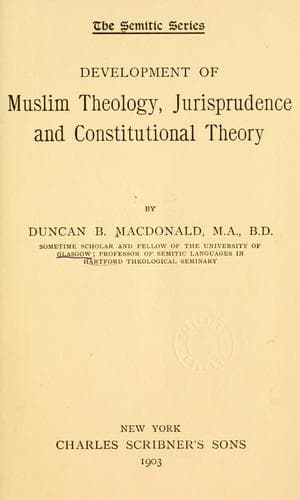
Development of Muslim Theology, Jurisprudence, and Constitutional Theory — John Shaqi
Development of Muslim Theology, Jurisprudence, and Constitutional TheoryMacDonald, Duncan Black
ReligionIslamic
Development of Muslim Theology, Jurisprudence, and Constitutional Theory
MacDonald, Duncan Black
Constitutional law (Islamic law); Islam -- Doctrines -- History; Islam and state -- History; Islamic law -- History
In these revolts the Shi‘a was worthy of its name, and split into many
separate divisions, according to the individuals of the house of Ali to
whom allegiance was rendered and who were regarded as leaders, titular or
real. These subdivisions differed, also, in the principle governing the
choice of a leader and in the attitude of the people toward him. Shi‘ism,
from being a political question, became theological. The position of
the Shi‘ite was and is that there must be a law (_nass_) regulating the
choice of the Imam, or leader of the Muslim community; that that law is
one of the most important dogmas of the faith and cannot have been left
by the Prophet to develop itself under the pressure of circumstances;
that there is such an Imam clearly pointed out and that it is the duty
of the Muslim to seek him out and follow him. Thus there was a party who
regarded the leadership as belonging to Ali himself, and then to any of
his descendants by any of his wives. These attached themselves especially
to his son Muhammad, known from his mother as Muhammad ibn al-Hanafiya,
who died in 81, and to his descendants and successors. It was in this
sect that the most characteristic Shi‘ite views first developed. This
Muhammad seems to have been the first concerning whom it was taught,
after his death, that he was being preserved by God alive in retirement
and would come forth at his appointed time to bring in the rule of
righteousness upon the earth. In some of the innumerable sub-sects the
doctrine of the deity, even, of Ali was early held, in others a doctrine
of metempsychosis, generally among men and especially from one Imam to
his successor; others, again, advanced the duty of seeking the rightful
Imam and rendering allegiance to him till it covered the whole field of
faith and morals—no more was required of the believer. To one of these
sects, al-Muqanna, “the Veiled Prophet of Khorasan,” adhered before he
started on his own account.
Public-domain text, read in full here on John Shaqi.
Reviews
Reviews
No reviews yet
Be the first to share your thoughts on this work.
Join the Discussion
Join the discussion
Sign in to leave a comment or review.
Sign InorCreate an account