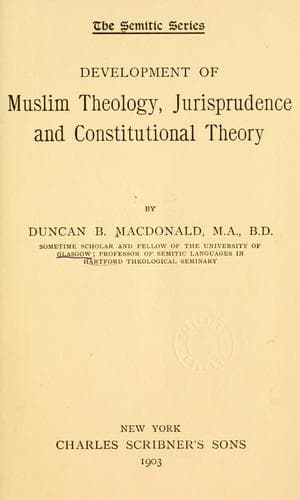
Development of Muslim Theology, Jurisprudence, and Constitutional TheoryMacDonald, Duncan Black
ReligionIslamic
Development of Muslim Theology, Jurisprudence, and Constitutional Theory
MacDonald, Duncan Black
Constitutional law (Islamic law); Islam -- Doctrines -- History; Islam and state -- History; Islamic law -- History
then would they allow themselves to be guided aright, as He has said,
(Qur. 7, 177); “whom God guideth aright, he allows himself to be guided
aright, and whom He leads astray, they are the losers.” God is able to
help the unbelieving aright and to be gracious unto them, so that they
shall become believing, but He wills that they shall be unbelieving as
is known. For He has made them impervious to all help and sealed their
hearts. Good and Evil happen according to the Destiny (_qada_) and Decree
(_qadar_) of God for good and evil, for the sweet and the bitter. We
know that the misfortune that befalls us is not in order that we may go
astray, and that the good fortune which befalls us is not in order that
we may go aright. We have no control over that which is good or hurtful
to us, except so far as God wills. We flee from our anxieties to God and
commit at all times our distress and poverty to Him. We teach that the
Qur’an is God’s Word, and that it is uncreated, and that whosoever says
that it is created is an unbeliever (_kafir_). We believe that God at
the Day of Resurrection (_yawm al-qiyama_) will be visible to the eyes,
as the moon is seen upon the night of the full moon; the believers will
see Him, according to traditions which have come down from the Prophet.
We teach that while the believers will see Him, the unbelievers will be
separated from Him by a wall of division, as God has said, (Qur. 83, 15);
“Surely not! They will be separated from their Lord, upon that Day.”
We teach that Moses besought God that he might see Him in this world;
then God revealed Himself to the mountain and turned it into dust and
taught Moses thereby that he could not see Him in this world (Qur. 7,
139). We are of the opinion that we may not accuse anyone of unbelief
(_kufr_), who prays towards Mecca, on account of sin committed by him,
such as unchastity, theft, wine drinking, as the Kharijites believe,
who judge that these thereby become unbelievers. We teach that whoever
commits a great sin (_kabira_), or anything like it, holding it to be
allowed, is an unbeliever, since he does not believe in its prohibition.
We teach that Islam is a wider idea than Faith (_iman_), so that not
every Islam is Faith. We believe that God turns the hearts upside down,
and holds them between two of His fingers, that He lays the heavens upon
a finger and the earth upon a finger, according to the tradition from
the Prophet. We believe that God will not leave in Hell any of those
who confess His Unity (_muwahhid_) and hold fast to the Faith, and that
there is no Hell for him whom the Prophet has by his witness appointed
to Paradise. We hope for Paradise for sinners and fear on their account,
that they will be punished in Hell. We teach that God will release a few
out of Hell, on account of Muhammad’s intercession (_shafa‘a_) after they
have been scorched there. We believe in the punishment of the grave. We
believe that the Tank (_hawd_) and the Balance are Verities: that the
Public-domain text, read in full here on John Shaqi.
Reviews
Reviews
No reviews yet
Be the first to share your thoughts on this work.
Elsewhere in the archive
Join the Discussion
Join the discussion
Sign in to leave a comment or review.
Sign InorCreate an account