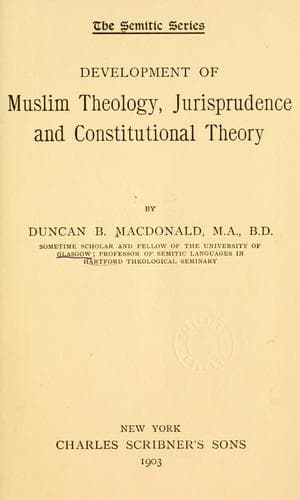
Development of Muslim Theology, Jurisprudence, and Constitutional TheoryMacDonald, Duncan Black
ReligionIslamic
Development of Muslim Theology, Jurisprudence, and Constitutional Theory
MacDonald, Duncan Black
Constitutional law (Islamic law); Islam -- Doctrines -- History; Islam and state -- History; Islamic law -- History
Bridge _as-Sirat_ is a Verity; that the Arousing (_ba‘th_) after death
is a Verity; that God will set up His creatures in a place (_mawqif_)
and will hold a reckoning with the Believers.[1] We believe that Faith
(_iman_) consists in word (_qawl_) and in work (_amal_) and that it
increases and diminishes. We trust in the sound Traditions handed down
from the Apostle of God, which trustworthy people (_thiqat_), just man
from just man, up to the Apostle, have transmitted. We hold by the love
of the early Believers (_salaf_), whom God chose to be Companions to the
Prophet, and we praise them with the praise with which God praised them,
and we carry on their succession. We assert that the Imam succeeding
the Apostle of God was Abu Bakr; that God through him made the Religion
(_din_) mighty, and caused him to conquer the Apostates (_murtadds_).
The Muslims made him their Imam, just as Muhammad had made him Imam at
prayers. Then followed [as legal Imam] Umar ibn al-Khattab; then Uthman
ibn Affan; his murderers killed him out of wickedness and enmity; then
Ali ibn Abi Talib. These are the Imams after the Apostle, and their
Khalifate is that of the Prophetic office [_i.e._, they are, though not
prophets, successors of the Prophet]. We bear witness of Paradise for
the Ten (_al-asharatu-l-mubashshara_), to whom the Apostle bore witness
of it, and we carry on the succession of the other Companions of the
Prophet and hold ourselves far from that which was in dispute between
them. We hold that the four Imams were in the true way, were rightly
guided and excellent, so that no one equals them in excellence. We hold
as true the traditions which the People of Tradition (_naql_) have
established, concerning the descent of God to the lowest heaven (_sama
ad-dunya_), and that the Lord will say, “Is there a supplicant? Is there
a seeker for forgiveness?” and the rest of that which they have handed
down and established, contrary to that which the mistaken and misled
opine. We ground ourselves in our opposition on the Qur’an, the _Sunna_
of the Prophet, the agreement of the Muslims and what is in accordance
therewith, but put forth no novelty (_bid‘a_) not sanctioned by God, and
opine of God nothing that we have not been taught. We teach that God will
come on the Day of Resurrection, as He has said, (Qur. 89, 23); “When
the earth shall be turned to dust, and the Lord shall appear and the
angels, rank on rank,” and that God is near to His servants, in what way
(_kayfa_) He wills, as He has said, (Qur. 50, 15); “and We are nearer to
him than the artery in his neck;” and (Qur. 53, 8); “Then He approached
and came near and was two bows’ length distant or even nearer.” To our
Religion (_din_) belongs further, that we on Fridays and on festival
days pray behind every person, pious and profane—so are the conditions
for congregational prayers, as it is handed down from Abd Allah ibn Umar
that he prayed behind al-Hajjaj. To our Religion belongs the wiping
Public-domain text, read in full here on John Shaqi.
Reviews
Reviews
No reviews yet
Be the first to share your thoughts on this work.
Elsewhere in the archive
Join the Discussion
Join the discussion
Sign in to leave a comment or review.
Sign InorCreate an account