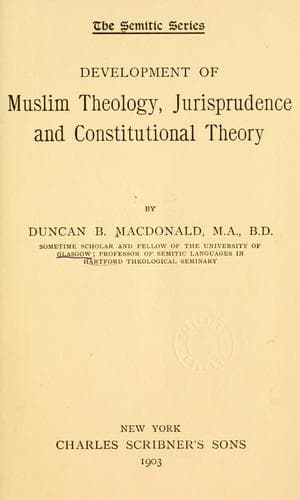
Development of Muslim Theology, Jurisprudence, and Constitutional TheoryMacDonald, Duncan Black
ReligionIslamic
Development of Muslim Theology, Jurisprudence, and Constitutional Theory
MacDonald, Duncan Black
Constitutional law (Islamic law); Islam -- Doctrines -- History; Islam and state -- History; Islamic law -- History
(_mash_) of the inner boots (_khuffs_) upon a journey and at home, in
contradiction to the deniers of this.[2] We uphold the prayer for peace
for the Imams of the Muslims, submission to their office, and maintain
the error of those who hold it right to rise against them whenever there
may be apparent in them a falling away from right. We are against armed
rebellion against them and civil war.
We believe in the appearance of anti-Christ (_ad-Dajjal_) according to
the tradition handed down from the Prophet; in the punishment of the
grave, and in Munkar and Nakir and in their questions to the buried in
their graves. We hold the tradition of the journey to heaven (_mi‘raj_,
Qur. 17) of Muhammad as true, and declare many of the visions in sleep to
be true, and we say that there is an explanation for them. We uphold the
alms for the dead of the Muslims and prayer for them, and believe that
God will help them therewith. We hold as true that there are enchanters
in the world, and that enchantment is and exists. We hold as a religious
duty the prayer which is held over the dead of those who have prayed
toward Mecca, whether they have been believers or godless; we uphold
also their right of testation. We acknowledge that Paradise and Hell are
created, and that whoever dies or is killed, dies or is killed at his
appointed time (_ajal_); that the articles of sustenance (_rizq_) from
God, with which He sustains His creatures, are permitted (_halal_) and
forbidden (_haram_);[3] that Satan makes evil suggestions to men, and
puts them in doubt, and causes them to be possessed, contrary to that
which the Mu‘tazilites and the Jahmites maintain, as God said, (Qur.
2, 276); “Those who take usury will [at the Resurrection] stand there
like one whom Satan causes to be possessed by madness,” and (Qur. 114,
4 ff.); “I take my refuge in God, from the evil suggestion, from the
stealthy one who makes suggestions in the hearts of men, by means of men
and Jinn.” We affirm that God may distinguish the pious by signs which
He manifests through them. Our teaching concerning the little children
of the polytheists (_mushriks_) is this, that God will kindle a fire in
the other world for them, and will say, “Run in there;”—as the tradition
says.[4] We believe that God knows what men do and what they will to do,
what happens and how that which does not happen, if it should happen,
would happen. We believe in the obedience of the Imams and in their
counsel of the Muslims. We consider right the separation from every
inciter to innovation (_bid‘a_) and the turning aside from the People of
wandering desires (_ahl al-ahwa_).—_Translated from the Arabic text in
Spitta’s Zur Geschichte al-As‘ari’s, pp. 133 ff._
IV
A SHORT CREED BY AL-GHAZZALI
An exposition of the Creed of the People of the Sunna on the two Words of
Witnessing (_kalimata-sh-shabada_) which form one of the Foundations of
Islam.
Public-domain text, read in full here on John Shaqi.
Reviews
Reviews
No reviews yet
Be the first to share your thoughts on this work.
Elsewhere in the archive
Join the Discussion
Join the discussion
Sign in to leave a comment or review.
Sign InorCreate an account