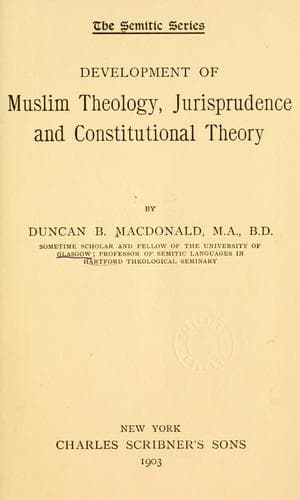
Development of Muslim Theology, Jurisprudence, and Constitutional TheoryMacDonald, Duncan Black
ReligionIslamic
Development of Muslim Theology, Jurisprudence, and Constitutional Theory
MacDonald, Duncan Black
Constitutional law (Islamic law); Islam -- Doctrines -- History; Islam and state -- History; Islamic law -- History
[A Mataridite who d. A.H. 537. This creed is still used as a
text-book in schools. It is translated from Cureton’s edition
(London, 1843) with the assistance of at-Taftazani’s commentary
(Constantinople, A.H. 1310). The asterisks mark the points on
which al-Mataridi differed from al-Ash‘ari.]
In the name of God, the merciful Compassionator.
The Shaykh, the Imam, Najm ad-Din Abu Hafs Umar ibn Muhammad ibn Ahmad
an-Nasafi—may God have mercy upon him!—said;—The People of Verity,
contradicting the Sceptics [_Sufistiqiya_, i.e., Sophists] say that the
real natures of things are validly established and that the science of
them is certain.
Further, that the sources of knowledge for mankind are three: the sound
Senses, true Narration (_khabar_), and Reason (_aql_). As for the
Senses, they are five: Hearing, Sight, Smell, Taste and Touch, and by
each sense you are informed concerning that for which it is appointed.
True Narration, again, is of two kinds. The one is Narration handed down
along a large number of lines of tradition (_mutawatir_); that is, it
is established by the tongues of a number of people of whom we cannot
imagine that they would agree in a lie. It compels a knowledge which
is of necessity (_daruri_), such as the knowledge of departed kings in
past times and of distant countries. And the second is Narration by the
Apostle (_rasul_) aided by miracle [_i.e._, Muhammad], and it compels
deduced knowledge (_istidlali_), and the knowledge established by it
resembles in certainty and fixity the knowledge established by necessity.
Then as for Reason, it is a cause of knowledge also; and whatever is
established by intuition (_badaha_) is of necessity, as the knowledge
that everything is greater than its parts; and whatever is established
by inference is acquired knowledge (_iktisabi_), as the existence of
fire from the appearance of smoke. And the Inner Light (_ilham_) with
the People of Verity is not one of the causes of knowledge as to the
soundness of anything.[5]
Further, the world in the totality of its parts is a thing originated
(_muhdath_), in that it consists of Substances (_ayns_) and Attributes
(_arads_). The Substances are what exist in themselves, and a substance
is either a compound, that is a body (_jism_), or not compounded like an
essence (_jawhar_), namely a division that is not further divided. And
the attributes are what do not exist in themselves but have a dependent
existence in bodies or essences, such as colors, tastes, conditions
(_kawns_), odors.
Public-domain text, read in full here on John Shaqi.
Reviews
Reviews
No reviews yet
Be the first to share your thoughts on this work.
Elsewhere in the archive
Join the Discussion
Join the discussion
Sign in to leave a comment or review.
Sign InorCreate an account