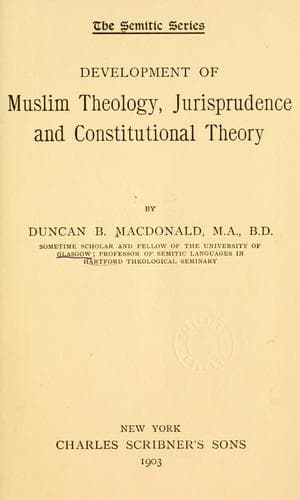
Development of Muslim Theology, Jurisprudence, and Constitutional TheoryMacDonald, Duncan Black
ReligionIslamic
Development of Muslim Theology, Jurisprudence, and Constitutional Theory
MacDonald, Duncan Black
Constitutional law (Islamic law); Islam -- Doctrines -- History; Islam and state -- History; Islamic law -- History
[3] The Mu‘tazilites held that articles of sustenance of a forbidden
nature, such as pork or wine, could not be called _rizq_ in this
technical sense; that God could not so use them. The orthodox retorted
that a man might live his life out on forbidden things; had he then been
independent of God as to his sustenance? The Mu‘tazilites defined _rizq_
as “a possession which its possessor eats” and as “that from which one is
not hindered from profiting”; the orthodox, as a name for that which God
sends to man and the other animals and they eat it and profit by it.
[4] Some will run into the fire and find themselves immediately in
Paradise; these would have been believers. Others will refuse, and will
be treated as their parents.
[5] This is not the normal doctrine of Islam and the commentators have to
explain this passage away. Consult in the chapters on theology, the whole
Sufi development and especially the views of al-Ghazzali. Al-Mataridi was
greatly influenced by Abu Hanifa, who was hostile to mystics. Notice,
too, the philosophical basis and beginning of this creed.
[6] A sect of the Mu‘tazilites held that a man could have two _ajals_,
one his end by a natural death appointed by God, the other his end by
a violent death, not so appointed. The “Philosophers” are said to have
held that one _ajal_ would be when the mechanism of the body ceased to
work through the failing of its essential moisture and heat, and another
_ajal_ might come through sicknesses and accident generally.
[7] See in bibliography, S. Keijzer, _Précis, etc_. Much help as to
details of religious ritual and law will be found in Hughes’s _Dictionary
of Islam_, Sachau’s _Muhammedanisches Recht_, Lane’s _Modern Egyptians_,
and commentary to his translation of the _Arabian Nights_, Burton’s
_Pilgrimage_, and Sell’s _Faith of Islam_.
INDEX OF NAMES AND ARABIC WORDS
Abad_i_, 300
Al-‘Abb_a_s, 10, 32
‘Abb_a_sids, 10, 32, 34, 39, 45, 50, 51, 53, 54, 56, 57, 91, 92-94, 97,
98, 132-135, 153, 154, 167, 169, 174
‘Abd, 294
‘Abd All_a_h, father of Mu_h_ammad, 350, f.
‘Abd All_a_h ibn az-Zubayr, 23, 25
‘Abd All_a_h ibn Maym_u_n, 40, 42-44
‘Abd All_a_h ibn ‘Umar, 298
‘Abd al-Mu’min, 248, 252
‘Abd al-Mu_tt_alib, 351
‘Abd al-Q_a_dir al-J_i_l_a_n_i_, 267
‘Abd ar-Ra_h_m_a_n, the Umayyad, 33
‘Abd ar-Razz_a_q, 271, f.
‘_A_bid, 173, 174
‘_A_bida, 174
Abkam, 340
Abraham, also Ibr_a_h_i_m, 43, 226, 345
Ab_u_ ‘Abd All_a_h ibn Karr_a_m; see Ibn Karr_a_m
Ab_u_-l-‘Al_a_ al-Ma‘arr_i_, 199
Ab_u_ Bakr, 1st Kh., 13-16, 23, 24, 36, 56, 71, 165, 200, 250, 268, 297,
307, 313, 346
Ab_u_ D_a_’_u_d as-Sijist_a_n_i_, 81
Ab_u_ Dharr, 207
Ab_u_-l-_H_ajj_a_j ibn _T_uml_u_s, 260
Ab_u_ _H_an_i_fa, 94-102, 106, 121, 127, 193, 309
Ab_u_ H_a_shim, 159, f.
Ab_u_ Hudhayl, 136-139, 159, 248
Ab_u_ Sahl, 325
Ab_u_ Shuj_a_‘ al-Ispah_a_n_i_, 351
Ab_u_ Sufy_a_n, 22
Ab_u_ Sulaym_a_n of Damascus, 175
Ab_u_ _Ta_lib, 10
Public-domain text, read in full here on John Shaqi.
Reviews
Reviews
No reviews yet
Be the first to share your thoughts on this work.
Elsewhere in the archive
Join the Discussion
Join the discussion
Sign in to leave a comment or review.
Sign InorCreate an account