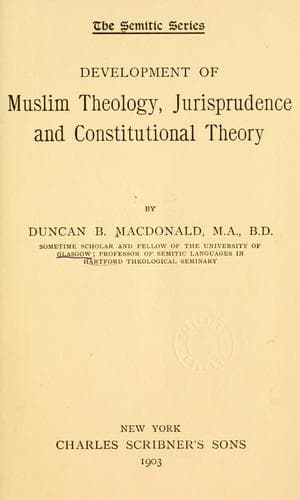
Development of Muslim Theology, Jurisprudence, and Constitutional TheoryMacDonald, Duncan Black
ReligionIslamic
Development of Muslim Theology, Jurisprudence, and Constitutional Theory
MacDonald, Duncan Black
Constitutional law (Islamic law); Islam -- Doctrines -- History; Islam and state -- History; Islamic law -- History
His plan was to unite all classes and parties in a conspiracy under one
head, promising to each individual the things which he considered most
desirable. For the Shi‘ites, it was to be a Shi‘ite conspiracy; for
the Kharijites, it took a Kharijite tinge; for Persian nationalists,
it was anti-Arab; for free-thinkers, it was frankly nihilistic. Abd
Allah himself seems to have been a sceptic of the most refined stamp.
The working of this plan was achieved by a system of grades like those
in freemasonry. His emissaries went out, settled each in a village and
gradually won the confidence of its inhabitants. A marked characteristic
of the time was unrest and general hostility to the government. Thus,
there was an excellent field for work. To the enormous majority of
those involved in it the conspiracy was Shi‘ite only, and it has been
regarded as such by many of its historians; but it is now tolerably
plain how simply nihilistic were its ultimate principles. The first
object of the missionary was to excite religious doubt in the mind of
his subject, by pointing out curious difficulties and subtle questions
in theology. At the same time he hinted that there were those who could
answer these questions. If his subject proved tractable and desired
to learn further, an oath of secrecy and absolute obedience and a fee
were demanded—all quite after the modern fashion. Then he was led up
through several grades, gradually shaking his faith in orthodox Islam
and its teachers and bringing him to believe in the idea of an Imam,
or guide in religious things, till the fourth grade was reached. There
the theological system was developed, and Islam, for the first time,
absolutely deserted. We have dealt already with the doctrine of the
Hidden Imam and with the present-day creed of Persia, that the twelfth in
descent from Ali is in hiding and will return when his time comes. But
down the same line of descent seven Imams had been reckoned to a certain
vanished Isma‘il, and this Isma‘il was adopted by Abd Allah ibn Maymun
as his Imam and as titular head of his conspiracy. Hence, his followers
are called Isma‘ilians and Seveners (_Sab‘iya_). The story which is told
of the split between the Seveners and the Twelvers, which were to be,
is characteristic of the whole movement and of the wider divergence of
the Seveners from ordinary Islam and its laws. The sixth Imam was Ja‘far
as-Sadiq (d. A.H. 148); he appointed his son Isma‘il as his successor.
But Isma‘il was found drunk on one occasion, and his father in wrath
passed the Imamship on to his brother, Musa al-Qazam, who is accordingly
reckoned as seventh Imam by the Twelvers. One party, however, refused to
recognize this transfer. Isma‘il’s drunkenness, they held, was a proof
of his greater spirituality of mind; he did not follow the face-value
(_zahr_) of the law, but its hidden meaning (_batn_). This is an example
of a tendency, strong in Shi‘ism, to find a higher spiritual meaning
Public-domain text, read in full here on John Shaqi.
Development of Muslim Theology, Jurisprudence, and Constitutional Theory — John Shaqi
Reviews
Reviews
No reviews yet
Be the first to share your thoughts on this work.
Join the Discussion
Join the discussion
Sign in to leave a comment or review.
Sign InorCreate an account