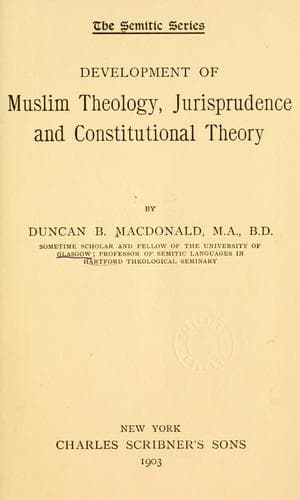
Development of Muslim Theology, Jurisprudence, and Constitutional Theory — John Shaqi
Development of Muslim Theology, Jurisprudence, and Constitutional TheoryMacDonald, Duncan Black
ReligionIslamic
Development of Muslim Theology, Jurisprudence, and Constitutional Theory
MacDonald, Duncan Black
Constitutional law (Islamic law); Islam -- Doctrines -- History; Islam and state -- History; Islamic law -- History
swear to the words of some master or other, long dead.
[Sidenote: FATIMIDS]
This division of the Shi‘ites is the only one that exists in great
numbers down to the present day. The second of the two mentioned above
came to power earlier, ran a shorter course, and has now vanished from
the stage, leaving nothing but an historical mystery and two or three
fossilized, half-secret sects—strange survivals which, like the survivals
of geology, tell us what were the living and dominant forces in the older
world. It will be worth while to enter upon some detail in reciting its
history, both for its own romantic interest and as an example of the
methods of Shi‘ite propaganda. Its success shows how the Abbasid empire
was gradually undermined and brought to its fall. It itself was the most
magnificent conspiracy, or rather fraud, in all history. To understand
its possibility and its results, we must hold in mind the nature of the
Persian race and the condition of that race at this time. Herodotus was
told by his Persian friends that one of the three things Persian youth
was taught was to tell the truth. That may have been the case in the time
of Herodotus, but certainly this teaching has had no effect whatever on
an innate tendency in the opposite direction; and it is just possible
that Herodotus’s friends, in giving him that information, were giving
also an example of this tendency. Travellers have been told curious
things before now, but certainly none more curious than this. As we know
the Persian in history, he is a born liar. He is, therefore, a born
conspirator. He has great quickness of mind, adaptability, and, apart
from religious emotion, no conscience. In the third century of the Hijra
(the ninth A.D.), the Persians were either devoted Shi‘ites or simple
unbelievers. The one class would do anything for the descendants of Ali;
the other, anything for themselves. This second class, further, would by
preference combine doing something for themselves with doing something
against Islam and the Arabs, the conquerors of their country. So much by
way of premise.
In the early part of this third century, there lived at Jerusalem
a Persian oculist named Maymun. He was a man of high education,
professional and otherwise; had no beliefs to speak of, and understood
the times. He had a son, Abd Allah, and trained him carefully for a
career. Abd Allah, however—known as Abd Allah ibn Maymun—though he had
thought of starting as a prophet himself, saw that the time was not
ripe, and planned a larger and more magnificent scheme. This was to be
no ordinary conspiracy to burst after a few years or months, but one
requiring generations to develop. It was to bring universal dominion to
his descendants, and overthrow Islam and the Arab rule. It succeeded in
great part, very nearly absolutely.
[Sidenote: A UNIQUE CONSPIRACY]
Public-domain text, read in full here on John Shaqi.
Reviews
Reviews
No reviews yet
Be the first to share your thoughts on this work.
Join the Discussion
Join the discussion
Sign in to leave a comment or review.
Sign InorCreate an account