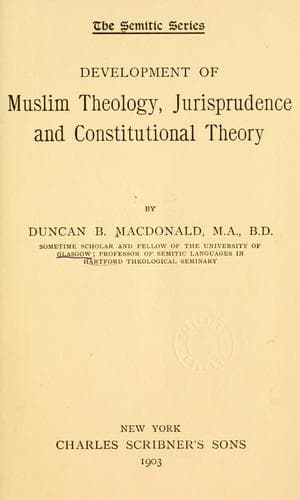
Development of Muslim Theology, Jurisprudence, and Constitutional TheoryMacDonald, Duncan Black
ReligionIslamic
Development of Muslim Theology, Jurisprudence, and Constitutional Theory
MacDonald, Duncan Black
Constitutional law (Islamic law); Islam -- Doctrines -- History; Islam and state -- History; Islamic law -- History
Such, then, was the system that those who passed the fourth degree
learned and accepted. The great majority did not pass beyond; but those
who were judged worthy were admitted to three further degrees. In these
degrees, their respect for religious teaching of every kind, doctrinal,
moral, ritual, was gradually undermined; the Prophets and their works
were depreciated and philosophy and philosophers put in their place. The
end was to lead the very few who were admitted to the inmost secrets of
the conspiracy to the same position as its founder. It is clear what
a tremendous weapon, or rather machine, was thus created. Each man
was given the amount of light he could bear and which was suited to
his prejudices, and he was made to believe that the end of the whole
work would be the attaining of what he regarded as most desirable. The
missionaries were all things to all men, in the broadest sense, and could
work with a Kharijite fanatic, who longed for the days of Umar; a Bedawi
Arab, whose only idea was plunder; a Persian driven to wild cries and
tears by the thought of the fate of Ali, the well-beloved, and of his
sons; a peasant, who did not care for any family or religion but only
wished to live in peace and be let alone by the tax-gatherers; a Syrian
mystic, who did not know very well what he thought, but lived in a world
of dreams; or a materialist, whose desire was to clear all religions out
of the way and give humanity a chance. All was fish that came to their
net. So the long seed-planting went on. Abd Allah ibn Maymun had to flee
to Salamiya in Syria, died there and went to his own place—if he got
his deserts, no desirable one—and Ahmad, his son or grandson, took up
the work in his stead. With him the movement tends to the surface, and
we begin to touch hard facts and dates. In southern Mesopotamia—what is
called the Arab Iraq—we find a sect appearing, nicknamed Qarmatians, from
one of their leaders. In A.H. 277 (A.D. 890-1) they were sufficiently
numerous and knew their strength enough to hold a fortress and thus enter
upon open rebellion. They were peasants, we must remember, Nabateans
and no Arabs, only Muslims by compulsion, and thus what we have here is
really a _Jacquerie_, or Peasants’ War. But a disturbance of any kind
suited the Isma‘ilians. From there the rising spread into Bahrayn and
on to south Arabia, varying in its character with the character of the
people.
[Sidenote: UBAYD ALLAH AL-MAHDI]
Public-domain text, read in full here on John Shaqi.
Reviews
Reviews
No reviews yet
Be the first to share your thoughts on this work.
Join the Discussion
Join the discussion
Sign in to leave a comment or review.
Sign InorCreate an account