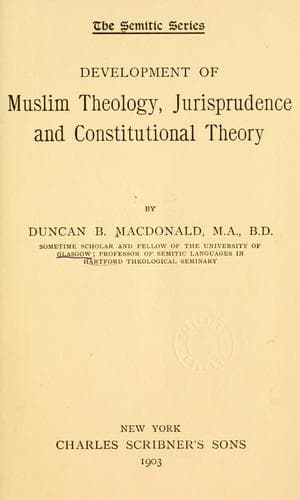
Development of Muslim Theology, Jurisprudence, and Constitutional TheoryMacDonald, Duncan Black
ReligionIslamic
Development of Muslim Theology, Jurisprudence, and Constitutional Theory
MacDonald, Duncan Black
Constitutional law (Islamic law); Islam -- Doctrines -- History; Islam and state -- History; Islamic law -- History
But there was another still more important development in progress. A
missionary had gone to North Africa and there worked with success among
the Berber tribes about Constantine, in what is now Algeria. These have
always been ready for any change. He gave himself out as forerunner
of the Mahdi, promised them the good of both worlds, and called them
to arms. The actual rising was in A.H. 289 (A.D. 902). Then there
appeared among them Sa‘id, the son of Ahmad, the son of Abd Allah, the
son of Maymun the oculist; but it was not under that name. He was now
Ubayd Allah al-Mahdi himself, a descendant of Ali and of Muhammad ibn
Isma‘il, for whom his ancestors were supposed to have worked and built
up this conspiracy. In A.H. 296 (A.D. 909) he was saluted as Commander
of the Faithful, with the title of al-Mahdi. So far the conspiracy had
succeeded. This Fatimid dynasty, so they called themselves from Fatima,
their alleged ancestress, the daughter of Muhammad, conquered Egypt and
Syria half a century later and held them till A.H. 567 (A.D. 1171). When
in A.H. 317 the Umayyads of Cordova also claimed the Khalifate and used
the title, there were three Commanders of the Faithful at one time in the
Muslim world. Yet it should be noticed that the constitutional position
of these Umayyads was essentially different from that of the Fatimids.
To the Fatimids, the Abbasids were usurpers. The Umayyads of Cordova,
on the other hand, held, like the Zaydites and some jurisconsults of
the highest rank, that, when Muslim countries were so far apart that
the authority of the ruler of the one could not make itself felt in the
other, it was lawful to have two Imams, each a true Successor of the
Prophet. The good of the people of Muhammad demanded it. Still, the unity
of the Khalifate is the more regular doctrine.
[Sidenote: AL-HAKIM]
Public-domain text, read in full here on John Shaqi.
Reviews
Reviews
No reviews yet
Be the first to share your thoughts on this work.
Join the Discussion
Join the discussion
Sign in to leave a comment or review.
Sign InorCreate an account