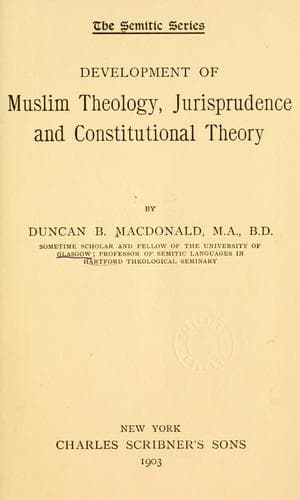
Development of Muslim Theology, Jurisprudence, and Constitutional TheoryMacDonald, Duncan Black
ReligionIslamic
Development of Muslim Theology, Jurisprudence, and Constitutional Theory
MacDonald, Duncan Black
Constitutional law (Islamic law); Islam -- Doctrines -- History; Islam and state -- History; Islamic law -- History
everywhere went law and justice, such as it was. Jurists accompanied
each army and were settled in the great camp cities which were built to
hold the conquered lands. Al-Basra and al-Kufa and Fustat, the parent
of Cairo, owe their origin to this, and it was in these new seats of
militant Islam that speculative jurisprudence arose and moulded the
Muslim system.
[Sidenote: RISE OF SPECULATIVE JURISPRUDENCE]
The early lawyers had much to do and much to learn, and it is to their
credit that they recognized both necessities. Muslim law is no product
of the desert or of the mind of Muhammad, as some have said; but rather
of the labor of these men, struggling with a gigantic problem. They
might have taken their task much more easily than they did; they might
have lived as Muhammad had done, from hand to mouth, and have concealed
their own sloth by force and free invention of authorities. But they
recognized their responsibility to God and man and the necessity of
building up a stable and complete means of rendering justice. These
armies of Muslims, we must remember, were not like the hordes of Attila
or Chingis Khan, destroyers only. The lands they conquered were put to
hard tribute, but it was under a reign of law. They recognized frankly
that it was for them that this mighty empire existed; but they recognized
also that it could continue to exist only with order and duty imposed
upon all. They saw, too, how deficient was their own knowledge and
learned willingly of the people among whom they had come. And here, a
second time, Roman law—the parent-law of the world—made itself felt.
There were schools of that law in Syria at Cæsarea and Beyrout, but we
need not imagine that the Muslim jurists studied there. Rather, it was
the practical school of the courts as they actually existed which they
attended. These courts were permitted to continue in existence till Islam
had learned from them all that was needed. We can still recognize certain
principles that were so carried over. That the duty of proof lies upon
the plaintiff, and the right of defending himself with an oath upon the
defendant; the doctrine of invariable custom and that of the different
kinds of legal presumption. These, as expressed in Arabic, are almost
verbal renderings of the pregnant utterances of Latin law.
[Sidenote: RESPONSA PRUDENTIUM; OPINION]
Public-domain text, read in full here on John Shaqi.
Reviews
Reviews
No reviews yet
Be the first to share your thoughts on this work.
Elsewhere in the archive
Join the Discussion
Join the discussion
Sign in to leave a comment or review.
Sign InorCreate an account