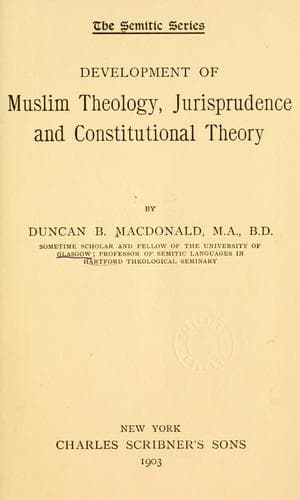
Development of Muslim Theology, Jurisprudence, and Constitutional TheoryMacDonald, Duncan Black
ReligionIslamic
Development of Muslim Theology, Jurisprudence, and Constitutional Theory
MacDonald, Duncan Black
Constitutional law (Islamic law); Islam -- Doctrines -- History; Islam and state -- History; Islamic law -- History
But most important of all was a liberty suggested by that system to the
Muslim jurisconsults. This was through the part played in the older
school by the _Responsa Prudentium_, answers by prominent lawyers to
questions put to them by their clients, in which the older law of the
Twelve Tables was expounded, expanded, and often practically set aside by
their comments. Sir Henry Maine thus states the situation: “The authors
of the new jurisprudence, during the whole progress of its formation,
professed the most sedulous respect for the letter of the code. They were
merely explaining it, deciphering it, bringing out its full meaning; but
then, in the result, by placing texts together, by adjusting the law to
states of fact which actually presented themselves, and by speculating
on its possible application to others which might occur, by introducing
principles of interpretation derived from the exegesis of other written
documents which fell under their observation, they educed a vast variety
of canons which had never been dreamt of by the compilers of the Twelve
Tables, and which were in truth rarely or never to be found there.” All
this precisely applies to the development of law in Islam.
[Sidenote: EQUITY; LEGAL FICTION]
The part of the Twelve Tables was taken by the statute law of the Qur’an
and the case law derived from the Usage of Muhammad; that of the Roman
_Iurisprudentes_ by those speculative jurists who worked mostly outside
of al-Madina in the camp cities of Mesopotamia and Syria—the very name
for lawyer in Arabic, _faqih_, plural _fuqaha_, is a translation of
_prudens_, _prudentes_; and that of the _Responsa_, the answers, by the
“Opinion” which they claimed as a legitimate legal method and source.
Further, the validity of a general agreement of jurisconsults “reminds
us of the rescript of Hadrian, which ordains that, if the opinions
of the licensed _prudentes_ all agreed, such common opinion had the
force of statute; but if they disagreed, the judge might follow which
he chose.” The Arabic term, _ra’y_, here rendered Opinion, has passed
through marked vicissitudes of usage. In old Arabic, before it, in the
view of some, began to keep bad company, it meant an opinion that was
thoughtful, weighed and reasonable, as opposed to a hasty dictate of
ill-regulated passion. In that sense it is used in a tradition—probably
forged—handed down from Muhammad. He was sending a judge to take charge
of legal affairs in al-Yaman, and asked him on what he would base his
legal decisions. “On the Qur’an,” he replied. “But if that contains
nothing to the purpose?” “Then upon your usage.” “But if that also fails
you?” “Then I will follow my own opinion.” And the Prophet approved his
purpose. A similar tradition goes back to Umar, the first Khalifa, and
it, too, is probably a later forgery, written to defend this source of
law. But, with the revolt against the use of Opinion, to which we shall
Public-domain text, read in full here on John Shaqi.
Reviews
Reviews
No reviews yet
Be the first to share your thoughts on this work.
Elsewhere in the archive
Join the Discussion
Join the discussion
Sign in to leave a comment or review.
Sign InorCreate an account