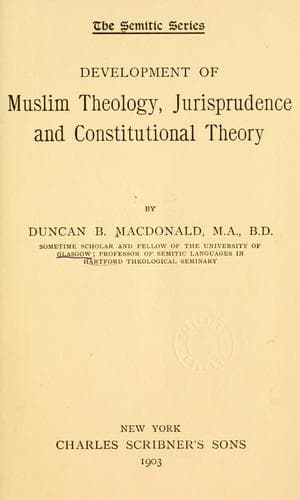
Development of Muslim Theology, Jurisprudence, and Constitutional TheoryMacDonald, Duncan Black
ReligionIslamic
Development of Muslim Theology, Jurisprudence, and Constitutional Theory
MacDonald, Duncan Black
Constitutional law (Islamic law); Islam -- Doctrines -- History; Islam and state -- History; Islamic law -- History
soon come, the term itself fell into grave disrepute and came to signify
an unfounded conclusion. In its extremest development it went beyond the
_Responsa_, which professed always to be in exact accord with the letter
of the older law, and attained to be Equity in the strict sense; that
is, the rejection of the letter of the law for a view supposed to be
more in accordance with the spirit of justice itself. Thus, Equity, in
the English sense, is the law administered by the Court of Chancery and
claims, in the words again of Sir Henry Maine, to “override the older
jurisprudence of the country on the strength of an intrinsic ethical
superiority.” In Roman law, as introduced by the edict of the Prætor, it
was the law of Nature, “the part of law ‘which natural reason appoints
for all mankind.’” This is represented in Islam under two forms, covered
by two technical terms. The one is that the legist, in spite of the
fact that the analogy of the fixed code clearly points to one course,
“considers it better” (_istihsan_) to follow a different one; and the
other is that, under the same conditions, he chooses a free course “for
the sake of general benefit to the community” (_istislah_). Further scope
of Equity Muslim law never reached, and the legitimacy of these two
developments was, as we shall see, bitterly contested. The freedom of
opinion, with its possibility of a system of Equity, had eventually to
be given up, and all that was left in its place was a permissibility of
analogical deduction (_qiyas_), the nearest thing to which in Western law
is Legal Fiction. In a word, the possibility of development by Equity was
lost, and Legal Fiction entered in its place. But this anticipates, and
we must return to the strictly historical movement.
Public-domain text, read in full here on John Shaqi.
Reviews
Reviews
No reviews yet
Be the first to share your thoughts on this work.
Elsewhere in the archive
Join the Discussion
Join the discussion
Sign in to leave a comment or review.
Sign InorCreate an account