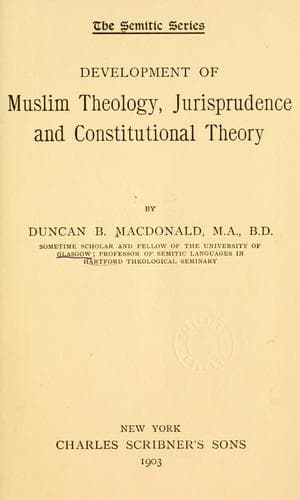
Development of Muslim Theology, Jurisprudence, and Constitutional TheoryMacDonald, Duncan Black
ReligionIslamic
Development of Muslim Theology, Jurisprudence, and Constitutional Theory
MacDonald, Duncan Black
Constitutional law (Islamic law); Islam -- Doctrines -- History; Islam and state -- History; Islamic law -- History
During the first thirty years after the death of Muhammad—the period
covered by the reigns of the four theocratic rulers whom Islam still
calls “the Four Just, or Rightly Guided Khalifas” (_al-Khulafa
ar-rashidun_)—the two twin studies of tradition (_hadith_) and of law
(_fiqh_) were fostered and encouraged by the state. The centre of that
state was still in al-Madina, on ground sacred with the memories of the
Prophet, amid the scenes where he had himself been lord and judge, and
under the conditions in which his life as ruler had been cast. All the
sources, except that of divine revelation, which had been open to him,
were open to his successors and they made full use of all. Round that
mother-hearth of Islam was still gathered the great body of the immediate
Companions of Muhammad, and they formed a deliberative or consulting
council to aid the Khalifa in his task. The gathering of tradition and
the developing of law were vital functions; they were the basis of the
public life of the state. This patriarchal period in Muslim history is
the golden age of Islam. It ended with the death of Ali, in the year 40
of the Hijra, and the succession of Mu‘awiya in the following year. “For
thirty years,” runs a tradition from the Prophet, “my People will tread
in my Path (_sunna_); then will come kings and princes.”
[Sidenote: GROWTH OF CANON LAW]
And so it was; Mu‘awiya was the first of the Umayyad dynasty and with him
and them Islam, in all but the name, was at an end. He and they were Arab
kings of the old type that had reigned before Muhammad at al-Hira and
Ghassan, whose will had been their law. The capital of the new kingdom
was Damascus; al-Madina became a place of refuge, a Cave of Adullam, for
the old Muslim party. There they might spin theories of state and of
law, and lament the good old days; so long as there was no rebellion,
the Umayyads cared little for those things or for the men who dreamt
them. Once, the Umayyads were driven to capture and sack the holy city,
a horror in Islam to this day. After that there was peace, the peace of
the accomplished fact. This is the genuinely Arab period in the history
of Islam. It is a period full of color and light and life; of love and
song, battle and feasting. Thought was free and conduct too. The great
theologian of the Greek Church, John of Damascus, held high office at the
Umayyad court, and al-Akhtal, a Christian at least in name, was their
poet laureate. It is true that the stated services of religion were
kept up and on every Friday the Khalifa had to entertain the people by
a display of eloquence and wit in the weekly sermon. But the old world
was dead and the days of its unity would never come again. So all knew,
except the irreconcilable party, the last of the true Muslims who still
haunted the sacred soil of al-Madina and labored in the old paths. They
gathered the traditions of the Prophet; they regulated their lives more
Public-domain text, read in full here on John Shaqi.
Reviews
Reviews
No reviews yet
Be the first to share your thoughts on this work.
Elsewhere in the archive
Join the Discussion
Join the discussion
Sign in to leave a comment or review.
Sign InorCreate an account