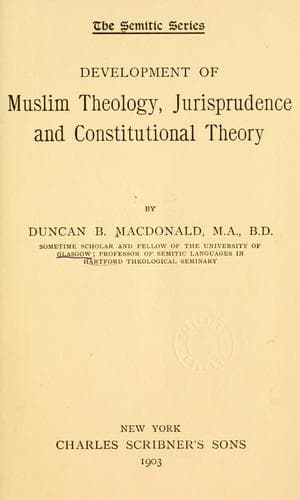
Development of Muslim Theology, Jurisprudence, and Constitutional TheoryMacDonald, Duncan Black
ReligionIslamic
Development of Muslim Theology, Jurisprudence, and Constitutional Theory
MacDonald, Duncan Black
Constitutional law (Islamic law); Islam -- Doctrines -- History; Islam and state -- History; Islamic law -- History
and more strictly by his usage; they gave ghostly council to the pious
who sought their help; they labored to build up elaborate systems of law.
But it was all elaboration and hypothetical purely. There was in it no
vitalizing force from practical life.
From this time on Muslim law has been more or less in the position held
by the canon law of the Roman Church in a country that will not recognize
it yet dares not utterly reject it. The Umayyads were statesmen and
opportunists; they lived, in legal things, as much from hand to mouth as
Muhammad had done. He cut all knots with divine legislation; they cut
them with the edge of their will. Under them, as under him, a system
of law was impossible. But at the same time, in quiet and in secret,
this canon law of Islam was slowly growing up, slowly rounding into
full perfection of detailed correlation. It was governing absolutely
the private lives of all the good Muslims that were left, and even the
godless Umayyads, as they had to preach on Fridays to the People of
Muhammad, so they had to deal with it cautiously and respectfully. Of
the names and lives of these obscure jurists little has reached us and
it is needless to give that little here. Only with the final fall of the
Umayyads, in the year of the Hijra 132, do we come into the light and see
the different schools forming under clear and definite leaders.
CHAPTER II
The Abbasid revolution; the compromise; the problem of the
Abbasids; the two classes of canon lawyers and theologians;
the rise of legal schools; Abu Hanifa; his application of
Legal Fiction; _istihsan_; the Qadi Abu Yusuf; Muhammad ibn
al-Hasan; Sufyan ath-Thawri; al-Awza‘i; Malik ibn Anas; the
Usage of al-Madina; _istislah_; the doctrine of Agreement; the
beginning of controversy; traditionalists or historical lawyers
versus rationalists or philosophical lawyers; ash-Shafi‘i, a
mediator and systematizer; the Agreement of the Muslim people
a formal source; “My People will never agree in an error;” the
resultant four sources, Qur’an, Usage, Analogy, Agreement; the
traditionalist revolt; Da’ud az-Zahiri and literalism; Ahmad
ibn Hanbal; the four abiding schools; the Agreement of Islam;
the Disagreement of Islam; _iurare in verba magistri_; the
degrees of authority; the canon and the civil codes in Islam;
their respective spheres; distribution of schools at present
day; Shi‘ite law; Ibadite law.
Public-domain text, read in full here on John Shaqi.
Reviews
Reviews
No reviews yet
Be the first to share your thoughts on this work.
Elsewhere in the archive
Join the Discussion
Join the discussion
Sign in to leave a comment or review.
Sign InorCreate an account