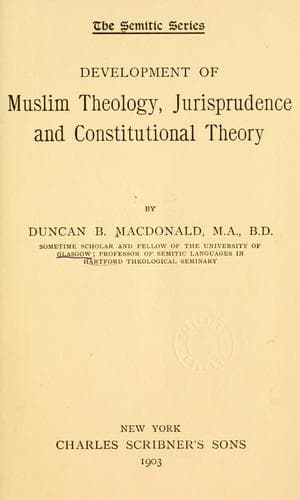
Development of Muslim Theology, Jurisprudence, and Constitutional TheoryMacDonald, Duncan Black
ReligionIslamic
Development of Muslim Theology, Jurisprudence, and Constitutional Theory
MacDonald, Duncan Black
Constitutional law (Islamic law); Islam -- Doctrines -- History; Islam and state -- History; Islamic law -- History
That great revolution which brought the Abbasid dynasty to power seemed
at first to the pious theologians and lawyers to be a return of the old
days. They dreamt of entering again into their rights; that the canon law
would be the full law of the land. It was only slowly that their eyes
were opened, and many gave up the vain contest and contented themselves
with compromise. This had been rare under the Umayyads; the one or two
canon lawyers who had thrown in their lot with them had been marked men.
Az-Zuhri (d. 124), a man of the highest moral and theological reputation
who played a very important part in the first codifying of traditions,
was one of these, and the later pious historians have had hard work to
smooth over his connection with the impious Umayyads. Probably—it may
be well to say here—the stories against the Umayyads have been much
heightened in color by their later tellers and also az-Zuhri, being a man
of insight and statesmanship, may have recognized that their rule was
the best chance for peace in the country. Muslims have come generally to
accept the position that unbelief on the part of the government, if the
government is strong and just, is better than true belief and anarchy.
This has found expression, as all such things do, in traditions put in
the mouth of the Prophet.
[Sidenote: THE PROBLEM OF THE ABBASIDS]
But while only a few canonists had taken the part of the Umayyads, far
more accepted the favors of the Abbasids, took office under them and
worked in their cause. The Abbasids, too, had need of such men. It was
practically the religious sentiment of the people that had overthrown
the Umayyads and raised them to power; and that religious sentiment,
though it could never be fully satisfied, must yet be respected and,
more important still, used. There is a striking parallel between the
situation then, and that of Scotland at the Revolution Settlement of
1688. The power of the Stuarts—that is, of the worldly Umayyads—had been
overthrown. The oppressed Church of the Covenant—that is, the old Muslim
party—had been freed. The state was to be settled upon a new basis. What
was that basis to be? The Covenanting party demanded the recognition of
the Headship of Christ—that the Kirk should rule the state, or should
be the state, and that all other religious views should be put under
penalty. The old Muslim party looked for similar things. That religious
life should be purified; that the canon law should be again the law of
the state; that the constitution of Umar should be restored. How the
Covenanters were disappointed, how much they got and how much they failed
to get, needs no telling here.
Public-domain text, read in full here on John Shaqi.
Reviews
Reviews
No reviews yet
Be the first to share your thoughts on this work.
Elsewhere in the archive
Join the Discussion
Join the discussion
Sign in to leave a comment or review.
Sign InorCreate an account