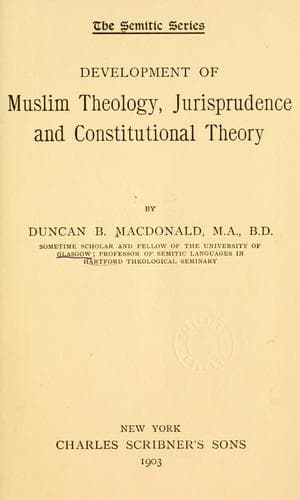
Development of Muslim Theology, Jurisprudence, and Constitutional TheoryMacDonald, Duncan Black
ReligionIslamic
Development of Muslim Theology, Jurisprudence, and Constitutional Theory
MacDonald, Duncan Black
Constitutional law (Islamic law); Islam -- Doctrines -- History; Islam and state -- History; Islamic law -- History
It was, then, under the pressure of necessity only that the following
sketch of the development of Muslim thought was divided into three parts.
By no possible arrangement did it seem feasible to treat the whole at
once. Intolerable confusions and unintelligible complications would, to
all appearance, be the result. As the most concrete and simple side,
the development of the state is taken first. Second, on account of the
shortness of the course which it ran, comes the development of the legal
ideas and schools. Third comes the long and thrice complicated thread
of theological thought. It is for the student to hold firmly in mind
that this division is purely mechanical and for convenience only; that
it corresponds to little or nothing in the real nature of the case.
This will undoubtedly become clear to him as he proceeds. He will meet
with the same names in all three divisions; he will meet with the same
technicalities and the same scholastic system. A treatise on canon law
is certainly different from one on theology, but each touches the other
at innumerable points; their authors may easily be the same; each will
be in great part unintelligible without the other. He must then labor to
merge these three sections again into one another. His principal helps
in this, along with diligent parallel reading, will be the chronological
table and the index. In the table he will watch the succession of men and
events grouped from all the three sections; from the index he will trace
the activities of each man in these different spheres. The index, too,
will give him the technical terms and he will observe their recurrence in
historical, legal, and theological theory. Further, it will serve him as
a vocabulary when he comes to read technical texts.
But, again, another warning is necessary. The sketch given here is
incomplete, not only in details but in the ground that it covers.
Important phases of Muslim law, theology, and state theory are of
necessity passed over entirely. Thus Babism is not touched at all and
the Shi‘ite theology and law hardly at all. The Ibadite systems have the
merest mention and Turkish and Persian mysticism are equally neglected.
For such weighty organizations the Darwish Fraternities are most
inadequately dealt with, and Muslim missionary enterprise might well be
treated at length. Guidance on these and other points the student will
seek in the bibliography. It, too, makes no pretence to completeness
and consists of selected titles only. But it will serve at least as an
introduction and clew to an exceedingly wide field. And it may be well
to state here, in so many words, that no work can be done in this field
without a reading knowledge of French and German, and no satisfactory
work without some knowledge of Arabic.
Public-domain text, read in full here on John Shaqi.
Reviews
Reviews
No reviews yet
Be the first to share your thoughts on this work.
Join the Discussion
Join the discussion
Sign in to leave a comment or review.
Sign InorCreate an account