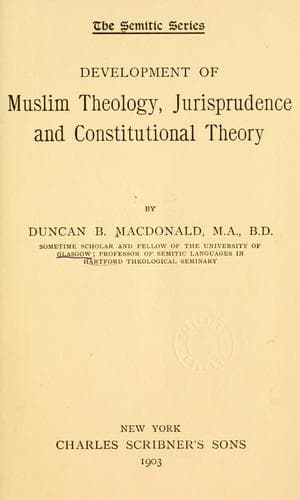
Development of Muslim Theology, Jurisprudence, and Constitutional TheoryMacDonald, Duncan Black
ReligionIslamic
Development of Muslim Theology, Jurisprudence, and Constitutional Theory
MacDonald, Duncan Black
Constitutional law (Islamic law); Islam -- Doctrines -- History; Islam and state -- History; Islamic law -- History
And, again, this sketch is incomplete because the development of Islam is
not yet over. If, as some say, the faith of Muhammad is a _cul-de-sac_,
it is certainly a very long one; off it many courts and doors open; down
it many peoples are still wandering. It is a faith, too, which brings
us into touching distance with the great controversies of our own day.
We see in it, as in a somewhat distorted mirror, the history of our own
past. But we do not yet see its end, even as the end of Christianity is
not yet in sight. It is for the student, then, to remember that Islam is
a present reality and the Muslim faith a living organism, a knowledge
of whose laws may be of life or death for us who are in another camp.
For there can be little doubt that the three antagonistic and militant
civilizations of the world are those of Christendom, Islam, and China.
When these are unified, or come to a mutual understanding, then, and only
then, will the cause of civilization be secure. To aid some little to the
understanding of Islam among us is the object of this book.
PART I
Constitutional Development
CHAPTER I
The death of Muhammad and the problem of the succession; the
parties; families of Hashimids, Umayyads and Abbasids; election
of Abu Bakr; nomination of Umar; his constitution; election
of Uthman; Umayyads in power; murder of Uthman; origin of
Shi‘ites; election of Ali; civil war; Mu‘awiya first Umayyad;
origin of Kharijites; their revolts; Ibadites; development
of Shi‘ites; al-Husayn at Karbala; different Shi‘ite
constitutional theories; doctrine of the hidden Imam; revolts
against Umayyads; rise of Abbasids; Umayyads of Cordova.
With the death of Muhammad at al-Madina in the year 11 of the Hijra
(A.D. 632), the community of Islam stood face to face with three great
questions. Of the existence of one they were conscious, at least in
its immediate form; the others lay still for their consciousness in
the future. The necessity was upon them to choose a leader to take the
place of the Prophet of God, and thus to fix for all time what was to
be the nature of the Muslim state. Muhammad had appointed no Joshua;
unlike Moses he had died and given no guidance as to the man who should
take up and carry on his work. If we can imagine the people of Israel
left thus helpless on the other side of the Jordan with the course of
conquest that they must pursue opening before them, we shall have a
tolerably exact idea of the situation in Islam when Muhammad dropped
the reins. Certainly, the people of Islam had little conception of what
was involved in the great precedent that they were about to establish,
but, nevertheless, there lies here, in the first elective council
which they called, the beginning of all the confusions, rivalries, and
uncertainties that were to limit and finally to destroy the succession of
the Commanders of the Faithful.
[Sidenote: EARLY PARTIES]
Public-domain text, read in full here on John Shaqi.
Reviews
Reviews
No reviews yet
Be the first to share your thoughts on this work.
Join the Discussion
Join the discussion
Sign in to leave a comment or review.
Sign InorCreate an account