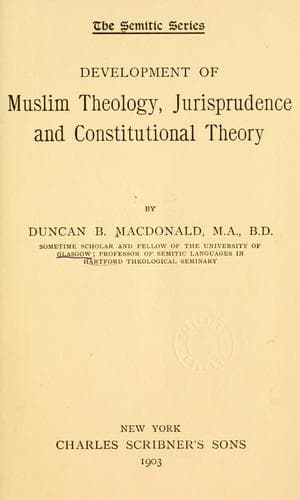
Development of Muslim Theology, Jurisprudence, and Constitutional TheoryMacDonald, Duncan Black
ReligionIslamic
Development of Muslim Theology, Jurisprudence, and Constitutional Theory
MacDonald, Duncan Black
Constitutional law (Islamic law); Islam -- Doctrines -- History; Islam and state -- History; Islamic law -- History
But though the speculative element in the school of Malik, apart from
its local and historical environment, which gave it unifying weight, was
essentially the same as in the school of Abu Hanifa, yet it is true that
at al-Madina it played a less important part. Malik used tradition more
copiously and took refuge in opinion less frequently. Without opinion, he
could not have built his system; but for him it was not so much a primary
principle as a means of escape. Yet one principle of great freedom he
did derive from it and lay down with clearness; it is the conception of
the public advantage (_istislah_). When a rule would work general injury
it is to be set aside even in the teeth of a valid analogy. This, it
will be seen, is nearly the same as the preference of Abu Hanifa. The
technical term _istislah_, chosen by Malik to express his idea, was
probably intended to distinguish it from that of Abu Hanifa, and also to
suggest in the public advantage (_maslaha_) a more valid basis than the
mere preference of the legist.
[Sidenote: THE DOCTRINE OF AGREEMENT]
Another conception which Malik and his school developed into greater
exactitude and force was that of the agreement (_ijma_). It will be
remembered that from the death of Muhammad all the surviving Companions
resident in al-Madina formed a kind of consultive council to aid the
Khalifa with their store of tradition and experience. Their agreement
on any point was final; it was the voice of the Church. This doctrine
of the infallibility of the body of the believers developed in Islam
until at its widest it was practically the same as the canon of catholic
truth formulated by Vincent of Lerins, _Quod ubique, quod semper, quod
ab omnibus_. But Malik, according to the usual view, had no intention of
granting any such deciding power to the outside world. The world for him
was al-Madina and the agreement of al-Madina established catholic verity.
Yet there are narratives which suggest that he approved the agreement and
local usage of al-Madina for al-Madina because they suited al-Madina.
Other places might also have their local usages which suited them better.
Public-domain text, read in full here on John Shaqi.
Reviews
Reviews
No reviews yet
Be the first to share your thoughts on this work.
Elsewhere in the archive
Join the Discussion
Join the discussion
Sign in to leave a comment or review.
Sign InorCreate an account