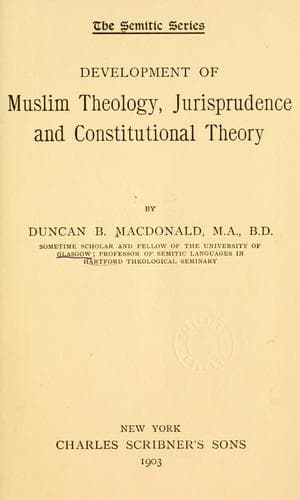
Development of Muslim Theology, Jurisprudence, and Constitutional TheoryMacDonald, Duncan Black
ReligionIslamic
Development of Muslim Theology, Jurisprudence, and Constitutional Theory
MacDonald, Duncan Black
Constitutional law (Islamic law); Islam -- Doctrines -- History; Islam and state -- History; Islamic law -- History
In the next school we shall find the principle of agreement put upon a
broader basis and granted greater weight. Finally, Malik is the first
founder of a system from whom a law book, the _Muwatta_ mentioned
above, has come down to us. It is not in the exact sense, a manual
or code; rather a collection of materials for a code with remarks by
the collector. He gives the traditions which seem to him of juristic
importance—about seventeen hundred in all—arranged according to subject,
and follows up each section, when necessary, with remarks upon the usage
of al-Madina, and upon his own view of the matter. When he cannot find
either tradition or usage, he evidently feels himself of sufficient
authority to follow his own opinion, and lay down on that basis a binding
rule. This, however, as we have seen, is very different from allowing
other people, outsiders to al-Madina, to do the same thing. The school
founded by Malik ibn Anas on these principles is one of the surviving
four. As that of Abu Hanifa spread eastward, so that of Malik spread
westward, and for a time crushed out all others. The firm grip which it
has especially gained in western North Africa may be due to the influence
of the Idrisids whose founder had to flee from al-Madina when Malik was
in the height of his reputation there, and also to hatred of the Abbasids
who championed the school of Abu Hanifa.
But now we pass from simple development to development through conflict.
Open conflict, so far as there had been any, had covered points of
detail; for example, the kind of opinion professed by Abu Hanifa, on the
one hand, and by Malik, on the other. One of the chiefest of the pupils
of Abu Hanifa, the Muhammad ibn al-Hasan already mentioned, spent three
years in study with Malik at al-Madina and found no difficulty in thus
combining his schools. The conflict of the future was to be different
and to touch the very basis of things. The muttering of the coming storm
had been heard for long, but it was now to burst. Exact dates we cannot
give, but the reaction must have been progressing in the latter part of
the life of Malik ibn Anas.
[Sidenote: HISTORICAL _V._ PHILOSOPHICAL LAWYERS]
Public-domain text, read in full here on John Shaqi.
Reviews
Reviews
No reviews yet
Be the first to share your thoughts on this work.
Elsewhere in the archive
Join the Discussion
Join the discussion
Sign in to leave a comment or review.
Sign InorCreate an account