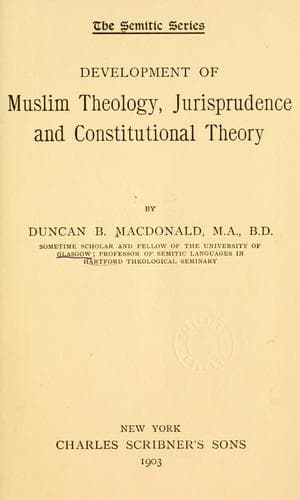
Development of Muslim Theology, Jurisprudence, and Constitutional TheoryMacDonald, Duncan Black
ReligionIslamic
Development of Muslim Theology, Jurisprudence, and Constitutional Theory
MacDonald, Duncan Black
Constitutional law (Islamic law); Islam -- Doctrines -- History; Islam and state -- History; Islamic law -- History
The distinction drawn above between traditionists and lawyers will
be remembered, and the promise of future collision which always has
come between historical or empirical, and speculative or philosophical
students of systems of jurisprudence. The one side points to the
absurdities, crudities, and inadequacies of a system based upon tradition
and developing by usage; the other says that we are not wise enough to
rewrite the laws of our ancestors. These urge a necessity; those retort
an inability. Add to this a belief on the part of the traditionists that
they were defending a divine institution and the situation is complete
as it now lay in Islam. The extreme right said that law should be based
on Qur’an and tradition only; the extreme left, that it was better to
leave untrustworthy and obscure traditions and work out a system of rules
by logic and the necessities of the case. To and fro between these two
extremes swayed the conflict to which we now come.
In that conflict three names stand out: ash-Shafi‘i who died in 204,
Ahmad ibn Hanbal who died in 241 and Da’ud az-Zahiri who died in 270.
Strangely enough, the first of these, ash-Shafi‘i, struck the mediating
note and the other two diverged further and further from the via media
thus shown toward a blank traditionism.
Ash-Shafi‘i is without question one of the greatest figures in the
history of law. Perhaps he had not the originality and keenness of Abu
Hanifa; but he had a balance of mind and temper, a clear vision and
full grasp of means and ends that enabled him to say what proved to be
the last word in the matter. After him came attempts to tear down; but
they failed. The fabric of the Muslim canon law stood firm. There is a
tradition from the Prophet that he promised that with the end of every
century would come a restorer of the faith of his people. At the end of
the first century was the pious Khalifa, Umar ibn Abd al-Aziz, who by
some accident strayed in among the Umayyads. At the end of the second
came ash-Shafi‘i. His work was to mediate and systematize and bore
especially on the sources from which rules of law might be drawn. His
position on the positive side may be stated as one of great reverence
for tradition. “If you ever find a tradition from the Prophet saying
one thing,” he is reported to have said, “and a decision from me saying
another thing, follow the tradition.” An absolutely authentic—according
to Muslim rules of evidence—and clear tradition from the Prophet he
regarded as of equally divine authority with a passage in the Qur’an.
Both were inspired utterances, if slightly different in form; the Qur’an
was verbally inspired; such traditions were inspired as to their content.
And if such a tradition contradicted a Qur’anic passage and came after it
in time, then the written law of the Qur’an was abrogated by the oral law
of the tradition. But this involved grave difficulties. The speculative
jurists had defended their position from the beginning by pointing to
Public-domain text, read in full here on John Shaqi.
Reviews
Reviews
No reviews yet
Be the first to share your thoughts on this work.
Elsewhere in the archive
Join the Discussion
Join the discussion
Sign in to leave a comment or review.
Sign InorCreate an account