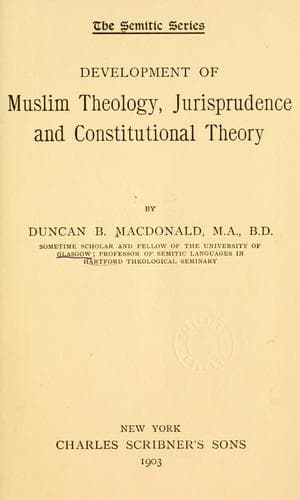
Development of Muslim Theology, Jurisprudence, and Constitutional TheoryMacDonald, Duncan Black
ReligionIslamic
Development of Muslim Theology, Jurisprudence, and Constitutional Theory
MacDonald, Duncan Black
Constitutional law (Islamic law); Islam -- Doctrines -- History; Islam and state -- History; Islamic law -- History
the many contradictory traditions which were afloat, and asking how the
house of tradition could stand when so divided against itself. A means
of reconciling traditions had to be found, and to this ash-Shafi‘i gave
himself. We need not go over his methods here; they were the same that
have always been used in such emergencies. The worship of the letter led
to the straining of the letter, and to explaining away of the letter.
[Sidenote: AGREEMENT AS A SOURCE]
But there lay a rock in his course more dangerous than any mere
contradiction in differing traditions. Usages had grown up and taken fast
hold which were in the teeth of all traditions. These usages were in the
individual life, in the constitution of the state, and in the rules and
decisions of the law courts. The pious theologian and lawyer might rage
against them as he chose; they were there, firmly rooted, immovable.
They were not arbitrary changes, but had come about in the process of
time through the revolutions of circumstances and varying conditions.
Ash-Shafi‘i showed his greatness by recognizing the inevitable and
providing a remedy. This lay in an extension of the principle of
agreement and the erection of it into a formal source. Whatever the
community of Islam has agreed upon at any time, is of God. We have met
this principle before, but never couched in so absolute and catholic a
form. The agreement of the immediate Companions of Muhammad had weight
with his first Successors. The agreement of these first Companions and
of the first generation after them, had determining weight in the early
church. The agreement of al-Madina had weight with Malik ibn Anas. The
agreement of many divines and legists always had weight of a kind. Among
lawyers, a principle, to the contrary of which the memory of man ran not,
had been determining. But this was wider, and from this time on the unity
of Islam was assured. The evident voice of the People of Muhammad was to
be the voice of God. Yet this principle, if full of hope and value for
the future, involved the canonists of the time in no small difficulties.
Was it conceivable that the agreement could override the usage of the
Prophet? Evidently not. There must, then, they argued, once have existed
some tradition to the same effect as the agreement, although it had now
been lost. Some such lost authority must be presupposed. This can remind
us of nothing so much as of the theory of the inerrant but lost original
of the Scriptures. And it had the fate of that theory. The weight of
necessity forced aside any such trifling and the position was frankly
admitted that the agreement of the community was a safer and more certain
basis than traditions from the Prophet. Traditions were alleged to that
effect. “My People will never agree in an error,” declared Muhammad, or,
at least, the later church made him so declare.
[Sidenote: ANALOGY; THE FOUR SOURCES]
Public-domain text, read in full here on John Shaqi.
Reviews
Reviews
No reviews yet
Be the first to share your thoughts on this work.
Elsewhere in the archive
Join the Discussion
Join the discussion
Sign in to leave a comment or review.
Sign InorCreate an account