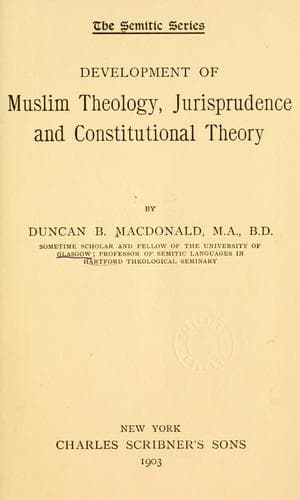
Development of Muslim Theology, Jurisprudence, and Constitutional TheoryMacDonald, Duncan Black
ReligionIslamic
Development of Muslim Theology, Jurisprudence, and Constitutional Theory
MacDonald, Duncan Black
Constitutional law (Islamic law); Islam -- Doctrines -- History; Islam and state -- History; Islamic law -- History
But ash-Shafi‘i found that even the addition of agreement to Qur’an and
Prophetic usage did not give him basis enough for his system. Opinion
he utterly rejected; the preference of Abu Hanifa and the conception of
the common welfare of Malik ibn Anas were alike to him. It is true also
that both had been practically saved under agreement. But he held fast
by analogy, whether based on the Qur’an or on the usage of the Prophet.
It was an essential instrument for his purpose. As was said, “The laws
of the Qur’an and of the usage are limited; the possible cases are
unlimited; that which is unlimited can never be contained in that which
is limited.” But in ash-Shafi‘i’s use of analogy there is a distinction
to be observed. In seeking to establish a parallelism between a case
that has arisen and a rule in the Qur’an or usage, which is similar
in some points but not precisely parallel, are we to look to external
points of resemblance, or may we go further and seek to determine the
reason (_illa_) lying behind the rule and from that draw our analogy?
The point seems simple enough and the early speculative jurists sought
the reason. For that they were promptly attacked by the traditionists.
Such a method was an attempt to look into the mysteries of God, they were
told; man has no business to inquire after reasons, all he has to do is
to obey. The point thus raised was fought over for centuries and schools
are classified according to their attitude toward it. The position of
ash-Shafi‘i seems to have been that the reason for a command was to be
considered in drawing an analogy, but that there must be some clear
guide, in the text itself, pointing to the reason. He thus left himself
free to consider the causes of the divine commands and yet produced the
appearance of avoiding any irreverence or impiety in doing so.
Such then are the four sources or bases (_asls_) of jurisprudence as
accepted and defined by ash-Shafi‘i—Qur’an, prophetic usage, analogy,
agreement. The last has come to bear more and more weight. Every
Shafi‘ite law book begins each section with words to this effect, “The
basis of this rule, before the agreement (_qabla-l-ijma_), is” Qur’an or
usage as the case may be. The agreement must put its stamp on every rule
to make it valid. Further, all the now existing schools have practically
accepted ash-Shafi‘i’s classification of the sources and many have
contended that a lawyer, no matter what his school, who does not use all
these four sources, cannot be permitted to act as a judge. Ash-Shafi‘i
has accomplished his own definition of a true jurist, “Not he is a jurist
who gathers statements and prefers one of them, but he who establishes a
new principle from which a hundred branches may spring.”
[Sidenote: DA’UD AZ-ZAHIRI]
Public-domain text, read in full here on John Shaqi.
Reviews
Reviews
No reviews yet
Be the first to share your thoughts on this work.
Elsewhere in the archive
Join the Discussion
Join the discussion
Sign in to leave a comment or review.
Sign InorCreate an account