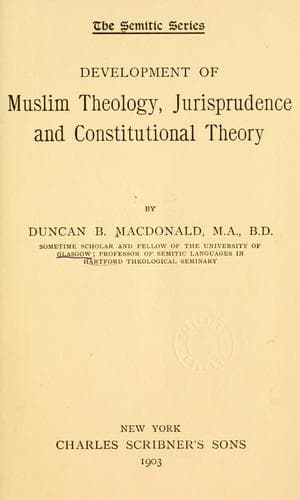
Development of Muslim Theology, Jurisprudence, and Constitutional TheoryMacDonald, Duncan Black
ReligionIslamic
Development of Muslim Theology, Jurisprudence, and Constitutional Theory
MacDonald, Duncan Black
Constitutional law (Islamic law); Islam -- Doctrines -- History; Islam and state -- History; Islamic law -- History
Finally, it may be well to notice an important and necessary modification
which holds as to the above statement that a Muslim may choose any
one of the four schools and may then follow its rules. As might be
expected, geographical influences weigh overwhelmingly in this choice.
Certain countries are Hanifite or Shafi‘ite; in each, adherents of the
other sects are rare. This geographical position may be given roughly
as follows: central Asia, northern India, and the Turks everywhere are
Hanifite. Lower Egypt, Syria, southern India and the Malay Archipelago
are Shafi‘ite. Upper Egypt and North Africa west of Egypt are Malikite.
Practically, only the Wahhabites in central Arabia are Hanbalites.
Further, the position holds in Islam that the country, as a whole,
follows the legal creed of its ruler, just as it follows his religion.
It is not only _cuius regio eius religio_, but _cuius religio eius lex_.
Again and again, a revolution in the state has driven one legal school
from power and installed another. Yet the situation occurs sometimes that
a sovereign finds his people divided into two parties, each following
a different rite, and he then recognizes both by appointing Qadis
belonging to both, and enforcing the decisions of these Qadis. Thus, at
Zanzibar, at present, there are eight Ibadite judges and two Shafi‘ite,
all appointed by the Sultan and backed by his authority. On the other
hand, the Turkish government, ever since it felt itself strong enough,
has thrown the full weight of its influence on the Hanifite side. In
almost all countries under its rule it appoints Hanifite judges only;
valid legal decisions can be pronounced only according to that rite. The
private needs of non-Hanifites are met by the appointment of salaried
_Muftis_—givers of _fatwas_, or legal opinions—of the other rites.
[Sidenote: IBADITES]
Public-domain text, read in full here on John Shaqi.
Reviews
Reviews
No reviews yet
Be the first to share your thoughts on this work.
Elsewhere in the archive
Join the Discussion
Join the discussion
Sign in to leave a comment or review.
Sign InorCreate an account