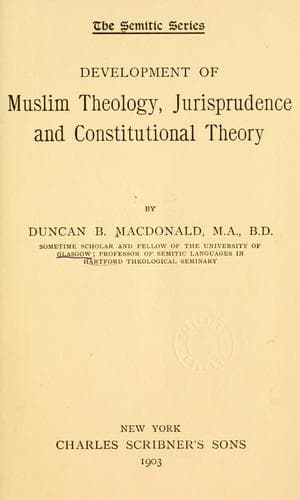
Development of Muslim Theology, Jurisprudence, and Constitutional TheoryMacDonald, Duncan Black
ReligionIslamic
Development of Muslim Theology, Jurisprudence, and Constitutional Theory
MacDonald, Duncan Black
Constitutional law (Islamic law); Islam -- Doctrines -- History; Islam and state -- History; Islamic law -- History
In the above sketch there have been of necessity two considerable
omissions. The one is of Shi‘ite and the other of Ibadite law. Neither
seems of sufficient importance to call for separate treatment. The legal
system of the Shi‘ites is derived from that of the so-called Sunnites
and differs in details only. We have seen already (p. 38) that the
Shi‘ites still have Mujtahids who are not bound to the words of a master,
but can give decisions on their own responsibility. These seem to have
in their hands the teaching power which strictly belongs only to the
Hidden Imam. They thus represent the principle of authority which is the
governing conception of the Shi‘a. The Sunnites, on the other hand, have
reached the point of recognizing that it is the People of Muhammad as a
whole which rules through its agreement. In another point the Shi‘ite
conception of authority affects their legal system. They utterly reject
the idea of co-ordinate schools of law; to the doctrine of the varying
(_ikhtilaf_) as it is called, and the liberty of diversity which lies in
it, they oppose the authority of the Imam. There can be only one truth
and there can be no trifling with it even in details. Among the Shi‘ites
of the Zaydite sect this was affected also by their philosophical
studies and a philosophical doctrine of the unity of truth; but to the
Imamites it is an authoritative necessity and not one of thought. Thus
on two important points the Shi‘ites lack the possibility of freedom and
development which is to be found with the Sunnites. Of the jurisprudence
of the Ibadites we know comparatively little. A full examination of
Ibadite _fiqh_ would be of the highest interest, as the separation of its
line of descent goes far back behind the formation of any of the orthodox
systems and it must have been codified to a greater or less extent by
Abd Allah ibn Ibad himself. Its basis appears to be threefold, Qur’an,
prophetic usage, agreement—naturally that of the Ibadite community. There
is no mention of analogy, and traditions seem to have been used sparingly
and critically. Qur’an bore the principal emphasis. See above, (p. 26)
for the Ibadite position on the form of the state and on the nature of
its headship.
PART III
Theology.
CHAPTER I
The three principles in the development; first religious
questionings; Murji’ites, Kharijites, Qadarites; influence of
Christianity; the Umayyads and Abbasids; the Mu‘tazilites; the
Qualities of God; the Vision of God; the creation of the Qur’an.
[Sidenote: THE THREE PRINCIPLES]
Public-domain text, read in full here on John Shaqi.
Reviews
Reviews
No reviews yet
Be the first to share your thoughts on this work.
Elsewhere in the archive
Join the Discussion
Join the discussion
Sign in to leave a comment or review.
Sign InorCreate an account