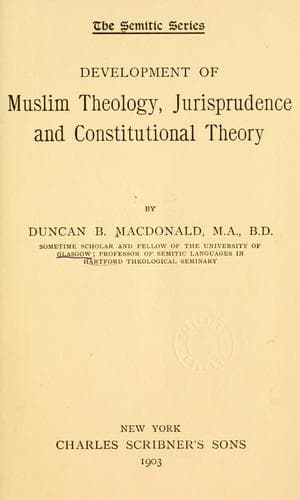
Development of Muslim Theology, Jurisprudence, and Constitutional TheoryMacDonald, Duncan Black
ReligionIslamic
Development of Muslim Theology, Jurisprudence, and Constitutional Theory
MacDonald, Duncan Black
Constitutional law (Islamic law); Islam -- Doctrines -- History; Islam and state -- History; Islamic law -- History
Before entering upon a consideration of the development of the theology
of Islam, it will be well to mark clearly the three principles which run
continuously through that development, which conditioned it for evil and
for good and which are still working in it. In dealing with jurisprudence
and with the theory of the state, we have already seen abundantly how
false is the current idea that Islam has ceased to grow and has no hope
of future development. The organism of Islam, like every other organism,
has periods of rest when it appears to have reached a _cul de sac_ and to
have outlived its life. But after these periods come others of renewed
quickening and its vital energy pours itself forth again _alter et idem_.
In the state, we saw how the old realms passed into decrepitude and
decay, but new ones rose to take their places. The despotism by the grace
of God of formal Islam was tempered by the sacred right of insurrection
and revolution, and the People of Muhammad, in spite of kings and
princes, asserted, from time to time, its unquenchable vitality.
In theology the spirit breathes through single chosen men more than
through the masses; and, in consequence, our treatment of it will take
biographical form wherever our knowledge renders that possible.
But whether we have men or naked movements, the begetters of which are
names to us or less, three threads are woven distinctly through the web
of Muslim religious thought. There is tradition (_naql_); there is reason
(_aql_); and there is the unveiling of the mystic (_kashf_). They were
in the tissue of Muhammad’s brain and they have been in his church since
he died. Now one would be most prominent, now another, according to the
thinker of the time; but all were present to some degree. Tradition in
its strictest form lives now only with the Wahhabites and the Brotherhood
of as-Sanusi; reason has become a scholastic handmaid of theology except
among the modern Indian Mu‘tazilites, whom orthodox Islam would no more
accept as Muslims than a Trinitarian of the Westminster confession
would give the name of Christian to a Unitarian of the left wing; the
inner light of the mystic has assumed many forms, running from plainest
pantheism to mere devout ecstasy. But in the church of Muhammad they are
all working still; and the catholicity of Islam, in spite of zealots,
persecutions and counter-persecutions, has attained here, too, as in law,
a liberty of variety in unity. Two of the principles we have met already
in the students of _hadith_ and of speculative law. The Hanbalites
maintained in theology their devotion to tradition; they fought for
centuries all independent thinking which sought to rise above what the
fathers had told; they fought even scholastic theology of the strictest
type and would be content with nothing but the rehearsal of the old
dogmas in the old forms; they fought, too, the mystical life in all its
phases. On the other hand, Abu Hanifa was tinged with rationalism and
Public-domain text, read in full here on John Shaqi.
Reviews
Reviews
No reviews yet
Be the first to share your thoughts on this work.
Elsewhere in the archive
Join the Discussion
Join the discussion
Sign in to leave a comment or review.
Sign InorCreate an account