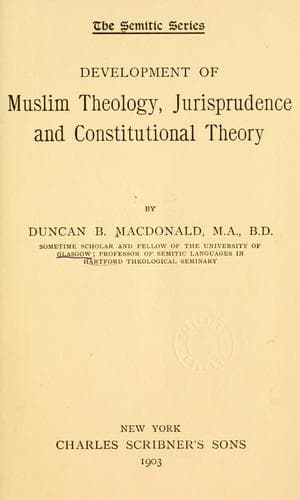
Development of Muslim Theology, Jurisprudence, and Constitutional TheoryMacDonald, Duncan Black
ReligionIslamic
Development of Muslim Theology, Jurisprudence, and Constitutional Theory
MacDonald, Duncan Black
Constitutional law (Islamic law); Islam -- Doctrines -- History; Islam and state -- History; Islamic law -- History
Muhammad had ruled as an absolute monarch—a Prophet of God in his
own right. He had no son; though had he left such issue it is not
probable that it would have affected the direct result. Of Moses’s son
we hear nothing till long afterward, and then under very suspicious
circumstances. The old free spirit of the Arabs was too strong, and as
in the Ignorance (_al-jahiliya_), as they called the pre-Muslim age, the
tribes had chosen from time to time their chiefs, so it was now fixed
that in Islam the leader was to be elected by the people. But wherever
there is an election, there are parties; and this was no exception. Of
such parties we may reckon roughly four. There were the Early Believers,
who had suffered with Muhammad at Mecca, accompanied him to al-Madina
and had fought at his side through all the Muslim campaigns. These were
called _Muhajirs_, because they had made with him the Hijra or migration
to al-Madina. Then there was the party of the citizens of al-Madina,
who had invited him to come to them and had promised him allegiance.
These were called _Ansar_ or Helpers. Eventually we shall find these two
factions growing together and forming the one party of the old original
believers and Companions of Muhammad (_sahibs_, _i.e._, all those who
came in contact with the Prophet as believers and who died in Islam),
but at the first they stood apart and there was much jealousy between
them. Then, in the third place, there was the party of recent converts
who had only embraced Islam at the latest moment when Mecca was captured
by Muhammad, and no other way of escape for them was open. They were the
aristocratic party of Mecca and had fought the new faith to the last.
Thus they were but indifferent believers and were regarded by the others
with more than suspicion. Their principal family was descended from a
certain Umayya, and was therefore called Umayyad. There will be much
about this family in the sequel. Then, fourth, there was growing up a
party that might be best described as legitimists; their theory was that
the leadership belonged to the leader, not because he was elected to it
by the Muslim community, but because it was his right. He was appointed
to it by God as completely as Muhammad had been. This idea developed, it
is true, somewhat later, but it developed very rapidly. The times were
such as to force it on.
Public-domain text, read in full here on John Shaqi.
Reviews
Reviews
No reviews yet
Be the first to share your thoughts on this work.
Join the Discussion
Join the discussion
Sign in to leave a comment or review.
Sign InorCreate an account