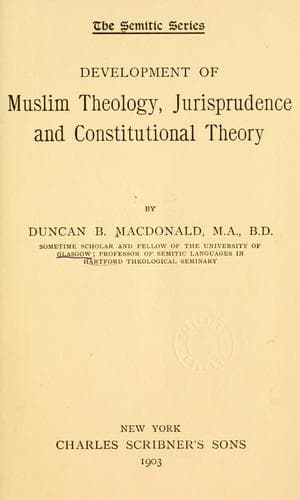
Development of Muslim Theology, Jurisprudence, and Constitutional TheoryMacDonald, Duncan Black
ReligionIslamic
Development of Muslim Theology, Jurisprudence, and Constitutional Theory
MacDonald, Duncan Black
Constitutional law (Islamic law); Islam -- Doctrines -- History; Islam and state -- History; Islamic law -- History
This sect of Qadarites, whose origin we have been conditioning, derived
its name from their position that a man possessed _qadar_, or power, over
his actions. One of the first of them was a certain Ma‘bad al-Juhani,
who paid for his heresy with his life in A.H. 80. Historians tell that
he with Ata ibn Yassar, another of similar opinions, came one day to the
celebrated ascetic, al-Hasan al-Basri (d. 110), and said, “O Abu Sa‘id,
those kings shed the blood of the Muslims, and do grievous things and say
that their works are by the decree of God.” To this al-Hasan replied,
“The enemies of God lie.” The story is only important as showing how the
times and their changes were widening men’s thoughts. Very soon, now,
we come from these drifting tendencies to a formal sect with a formal
secession and a fixed name. The Murji’ites and the Qadarites melt from
the scene, some of their tenets pass into orthodox Islam; some into the
new sect.
[Sidenote: ORIGIN OF MU’TAZILITES]
The story of its founding again connects with the outstanding figure
of al-Hasan al-Basri. He seems to have been the chief centre of the
religious life and movements of his time; his pupils appear and his
influence shows itself in all the later schools. Someone came to him
as he sat among his pupils and asked what his view was between the
conflicting Murji’ites and Wa‘idites, the first holding that the
committer of a great sin, if he had faith, was not an unbeliever, was to
be accepted as a Muslim and his case left in the hands of God; the other
laying more stress upon the threats (_wa‘id_) in the Book of God and
teaching that the committer of a great sin could not be a believer, that
he had, _ipso facto_, abandoned the true faith, must go into the Fire and
abide there. Before the master could reply, one of his pupils—some say
Amr ibn Ubayd (d. circ. 144), others, Wasil ibn Ata (d. 131)—broke in
with the assertion of an intermediate position. Such an one was neither
a believer nor an unbeliever. Then he left the circle which sat round
the master, went to another part of the mosque and began to develop his
view to those who gathered round him. The name believer (_mu’min_),
he taught, was a term of praise, and an evil-doer was not worthy of
praise, and could not have that name applied to him. But he was not an
unbeliever, either, for he assented to the faith. If he, then, died
unrepentant, he must abide forever in the Fire—for there are only two
divisions in the next world, heaven and hell—but his torments would be
mitigated on account of his faith. The position to which orthodox Islam
eventually came was that a believer could commit a great sin. If he did
so, and died unrepentant, he went to hell; but after a time would be
permitted to enter heaven. Thus, hell became for believers a sort of
purgatory. On this secession, al-Hasan only said “_I‘tazala anna_”—He
has seceded from us. So the new party was called the Mu‘tazila, the
Secession.
Public-domain text, read in full here on John Shaqi.
Reviews
Reviews
No reviews yet
Be the first to share your thoughts on this work.
Elsewhere in the archive
Join the Discussion
Join the discussion
Sign in to leave a comment or review.
Sign InorCreate an account