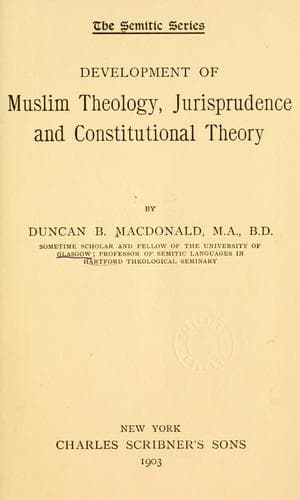
Development of Muslim Theology, Jurisprudence, and Constitutional TheoryMacDonald, Duncan Black
ReligionIslamic
Development of Muslim Theology, Jurisprudence, and Constitutional Theory
MacDonald, Duncan Black
Constitutional law (Islamic law); Islam -- Doctrines -- History; Islam and state -- History; Islamic law -- History
That, at least, is the story, which may be taken for what it
is worth. The fixed facts are the rise at the beginning of the second
century after the Hijra of a tolerably definite school of dissenters from
the traditional ideas, and their application of reason to the dogmas of
the Qur’an.
We have noted already the influence of Christianity on Muhammad through
the hermits of the desert. From it sprang the asceticism of Islam
and that asceticism grew and developed into quietism and thence into
mysticism. The last step was still in the future, but already at this
time there were wandering monks who imitated their Christian brethren in
the wearing of a coarse woollen frock and were thence called Sufis, from
_suf_, wool. It was not long before Sufi came to mean mystic, and the
third of the three great threads was definitely woven into the fabric of
Muslim thought. But that was not the limit of Christian influence. Those
anchorites in their caves and huts had little training in the theology of
the schools; the dogmas of their faith were of a practical simplicity.
But in the development of the Murji’ites and Qadarites it is impossible
to mistake the workings of the dialectic refinements of Greek theology
as developed in the Byzantine and Syrian schools. It is worth notice,
too, that, while the political heresies of the Shi‘ites and Kharijites
held sway mostly in Arabia, Mesopotamia, and Persia, these more religious
heresies seem to have arisen in Syria first and especially at Damascus,
the seat of the Umayyads.
[Sidenote: INFLUENCE OF JOHN OF DAMASCUS]
Public-domain text, read in full here on John Shaqi.
Reviews
Reviews
No reviews yet
Be the first to share your thoughts on this work.
Elsewhere in the archive
Join the Discussion
Join the discussion
Sign in to leave a comment or review.
Sign InorCreate an account