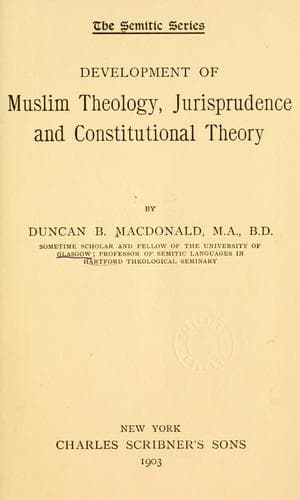
Development of Muslim Theology, Jurisprudence, and Constitutional TheoryMacDonald, Duncan Black
ReligionIslamic
Development of Muslim Theology, Jurisprudence, and Constitutional Theory
MacDonald, Duncan Black
Constitutional law (Islamic law); Islam -- Doctrines -- History; Islam and state -- History; Islamic law -- History
The Umayyad dynasty, we should remember, was in many ways a return to
pre-Muslim times and to an easy enjoyment of worldly things; it was a
rejection of the yoke of Muhammad in all but form and name. The fear
of the wrath of God had small part with the most of them; sometimes it
appeared in the form of an insane rebellion and defiance. Further, as
Muslim governments always have done, they sought aid in their task of
governing from their non-Muslim subjects. So it came about that Sergius,
the father of Johannes Damascenus, was treasurer under them and that
after his death, this John of Damascus himself, the last great doctor of
the Greek Church and the man under whose hands its theology assumed final
form, became wazir and held that post until he withdrew from the world
and turned to the contemplative life. In his writings and in those of
his pupil, Theodoras Abucara (d. A.D. 826), there are polemic treatises
on Islam, cast in the form of discussions between Christians and Muslims.
These represent, there can be little doubt, a characteristic of the time.
The close agreement of Murji’ite and Qadarite ideas with those formulated
and defended by John of Damascus and by the Greek Church generally can
only be so explained. The Murji’ite rejection of eternal punishment and
emphasis on the goodness of God and His love for His creatures, the
Qadarite doctrine of free-will and responsibility, are to be explained in
the same way as we have already explained the presence of sentences in
the Muslim _fiqh_ which seem to be taken bodily from the Roman codes. In
this case, also, we are not to think of the Muslim divines as studying
the writings of the Greek fathers, but as picking up ideas from them
in practical intercourse and controversy. The very form of the tract
of John of Damascus is significant, “When the Saracen says to you such
and such, then you will reply....” This, as a whole, is a subject which
calls for investigation, but so far it is clear that the influence of
Greek theology on Islam can hardly be overestimated. The one outstanding
fact of the enormous emphasis laid by both on the doctrine of the nature
of God and His attributes is enough. It may even be conjectured that
the harsher views developed by western Muslims, and especially by the
theologians of Spain, were due, on the other hand, to Augustinian and
Roman influence. It is, to say the least, a curious coincidence that
Spanish Islam never took kindly to metaphysical or scholastic theology,
in the exact sense, but gave almost all its energy to canon law.
[Sidenote: INFLUENCES AT BAGHDAD]
Public-domain text, read in full here on John Shaqi.
Reviews
Reviews
No reviews yet
Be the first to share your thoughts on this work.
Elsewhere in the archive
Join the Discussion
Join the discussion
Sign in to leave a comment or review.
Sign InorCreate an account