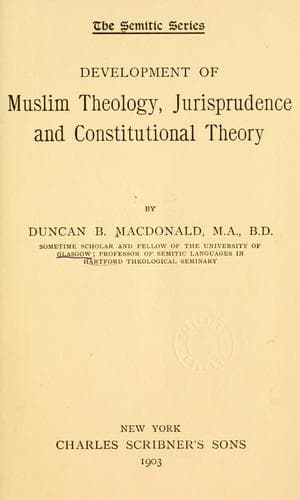
Development of Muslim Theology, Jurisprudence, and Constitutional TheoryMacDonald, Duncan Black
ReligionIslamic
Development of Muslim Theology, Jurisprudence, and Constitutional Theory
MacDonald, Duncan Black
Constitutional law (Islamic law); Islam -- Doctrines -- History; Islam and state -- History; Islamic law -- History
But there were other influences to come. With the fall of the Umayyads
and the rise of the Abbasids, the intellectual centre of the empire moved
to the basin of the Euphrates and the Tigris. The story of the founding
of Baghdad there, in 145, we have already heard. We have seen, too, that
the victory of the Abbasids was, in a sense, a conquest of the Arabs by
the Persians. _Græcia capta_ and the rest came true here; the battles
of al-Qadisiya and Nahawand were avenged; Persian ideas and Persian
religion began slowly to work on the faith of Muhammad. At the court of
the earliest Abbasids it was fashionable to affect a little free thought.
People were becoming enlightened and played with philosophy and science.
Greek philosophy, Zoroastrianism, Manichæism, the old heathenism of
Harran, Judaism, Christianity—all were in the air and making themselves
felt. So long as the adherents and teachers of these took them in a
purely academic way, were good subjects and made no trouble, the earlier
Abbasids encouraged their efforts, gathered in the scientific harvest,
paid well for translations, instruments, and investigations, and
generally posed as patrons of progress.
But a line had to be drawn somewhere and drawn tightly. The victory of
the Abbasids had raised high hopes among the Persian nationalists. They
had thought that they were rallying to the overthrow of the Arabs, and
found, when all was done, that they had got only another Arab dynasty.
So revolts had begun to break out afresh, and now, curiously enough,
they were of a marked religious character. They were an expression of
religious sects, Buddhistic, Zoroastrian, Manichæan, and parties with
prophetic leaders of their own; all are swept together by Muslim writers
as _Zindiqs_, probably literally, “initiates,” originally Manichæans,
thereafter, practically non-Muslims concealing their unbelief. For
when not in open revolt they must needs profess Islam. In 167, we find
al-Mahdi, who was also, it is true, much more strict than his father,
al-Mansur, appointing a grand inquisitor to deal with such heretics.
Al-Mansur, however, had contented himself with crushing actual rebellion;
and Christian, Jew, Zoroastrian, and heathen of Harran were tolerated so
long as they brought to him the fruits of Greek science and philosophy.
Public-domain text, read in full here on John Shaqi.
Reviews
Reviews
No reviews yet
Be the first to share your thoughts on this work.
Elsewhere in the archive
Join the Discussion
Join the discussion
Sign in to leave a comment or review.
Sign InorCreate an account