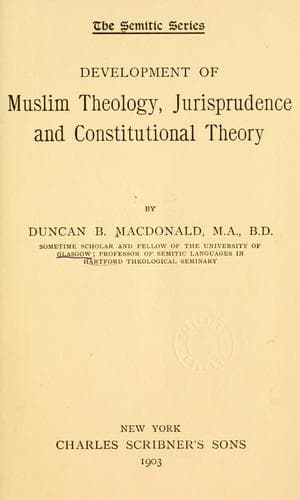
Development of Muslim Theology, Jurisprudence, and Constitutional TheoryMacDonald, Duncan Black
ReligionIslamic
Development of Muslim Theology, Jurisprudence, and Constitutional Theory
MacDonald, Duncan Black
Constitutional law (Islamic law); Islam -- Doctrines -- History; Islam and state -- History; Islamic law -- History
An-Nazzam (d. 231) has the credit among later historians of having made
use, to a high degree, of the doctrines of the Greek philosophers. He
was one of the Satans of the Qadarites, say they; he read the books of
the philosophers and mingled their teachings with the doctrines of the
Mu‘tazilites. He taught, in the most absolute way, that God could do
nothing to a creature, either in this world or in the next, that was
not for the creature’s good and in accordance with strict justice. It
was not only that God _would_ not do it; He had not the power to do
anything evil. Evidently the personality of God was fast vanishing behind
an absolute law of right. To this, orthodox Islam opposed the doctrine
that God could do anything; He could forgive whom He willed, and punish
whom He willed. Further, he taught that God’s willing a thing meant only
that He did it in accordance with His knowledge; and when He willed
the action of a creature that meant only that He commanded it. This is
evidently to evade phrases in the Qur’an. Man, again, he taught, was
spirit (_ruh_), and the body (_badan_) was only an instrument. But this
spirit was a fine substance which flowed in the body like the essential
oil in a rose, or butter in milk. In a universe determined by strict
law, man alone was undetermined. He could throw a stone into the air,
and by his action the stone went up; but when the force of his throw was
exhausted it came again under law and fell. If he had only asked himself
how it came to fall, strange things might have happened. But he, and all
his fellows, were only playing with words like counters. Further, he
taught that God had created all created things at once, but that He kept
them in concealment until it was time for them to enter on the stage of
visible being and do their part. All things that ever will exist are thus
existing now, but, in a sense, _in retentis_. This seems to be another
attempt to solve the problem of creation in time, and it had important
consequences. Further, the Qur’an was no miracle (_mu‘jiz_) to him. The
only miraculous elements in it are the narratives about the Unseen World,
and past things and things to come, and the fact that God deprived the
Arabs of the power of writing anything like it. But for that, they could
easily have surpassed it as literature. As a high Imamite he rejected
utterly agreement and analogy. Only the divinely appointed Imam had the
right to supplement the teaching of Muhammad. We pass over some of his
metaphysical views, odd as they are. The Muslim writers on theological
history have classified him rightly as more of a physicist than a
metaphysician. He had a concrete mind and that fondness for playing with
metaphysical paradoxes which often goes with it.
[Sidenote: BISHR; MA‘MAR]
Public-domain text, read in full here on John Shaqi.
Reviews
Reviews
No reviews yet
Be the first to share your thoughts on this work.
Elsewhere in the archive
Join the Discussion
Join the discussion
Sign in to leave a comment or review.
Sign InorCreate an account