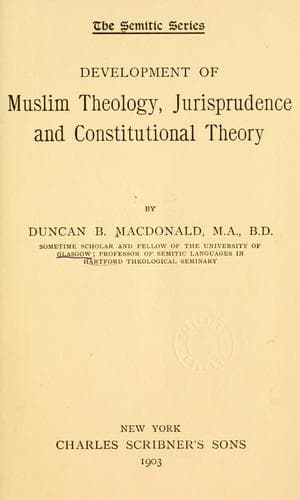
Development of Muslim Theology, Jurisprudence, and Constitutional TheoryMacDonald, Duncan Black
ReligionIslamic
Development of Muslim Theology, Jurisprudence, and Constitutional Theory
MacDonald, Duncan Black
Constitutional law (Islamic law); Islam -- Doctrines -- History; Islam and state -- History; Islamic law -- History
Another of the group was Bishr ibn al-Mu‘tamir. His principal
contribution was the doctrine of _tawlid_ and _tawallud_, begetting and
deriving. It is the transmission of a single action through a series of
objects; the agent meant to affect the first object only; the effect on
the others followed. Thus, he moves his hand, and the ring on his finger
is moved. What relation of responsibility, then, does he bear to these
derived effects? Generally, how are we to view a complex of causes acting
together and across one another? The answer of later orthodox Islam is
worth giving at this point. God creates in the man the will to move his
hand; He creates the movement of the hand and also the movement of the
ring. All is by God’s direct creation at the time. Further, could God
punish an infant or one who had no knowledge of the faith? Bishr’s reply
on the first point was simply a bit of logical jugglery to avoid saying
frankly that there was anything that God could not do. His answer on the
second was that God could have made a different and much better world
than this, a world in which all men might have been saved. But He was
not bound to make a better world—in this Bishr separates from the other
Mu‘tazilites—He was only bound to give man free-will and, then, either
revelation to guide him to salvation or reason to show him natural law.
With Ma‘mar ibn Abbad, the philosophies wax faster and more furious.
He succeeded in reducing the conception of God to a bare, indefinable
something. We could not say that God had knowledge. For it must be of
something in Himself or outside of Himself. If the first, then there was
a union of knower and known, and that is impossible; or a duality in the
divine nature, and that was equally impossible. Here Ma‘mar was evidently
on the road to Hegel. If the second, then His knowledge depended on
the existence of something other than Himself, and that did away with
His absoluteness. Similarly, he dealt with God’s Will. Nor could He be
described as _qadim_, prior to all things, for that word, in Arabic,
suggested sequence and time. By all this, he evidently meant that our
conceptions cannot be applied to God; that God is unthinkable by us.
On creation, he developed the ideas of an-Nazzam. Substances (_jisms_)
only were created by God, and by “substances” he seems to mean matter as
a whole; all changes in them, or it, come either of necessity from its
nature, as when fire burns, the sun warms; or of free-will, as always
in the animal world. God has no part in these things. He has given the
material and has nothing to do with the coming and going of separate
bodies; such are simple changes, forms of existence, and proceed from the
matter itself. Man is an incorporeal substance. The soul is the man and
his body is but a cover. This true man can only know and will; the body
perceives and does.
Public-domain text, read in full here on John Shaqi.
Reviews
Reviews
No reviews yet
Be the first to share your thoughts on this work.
Elsewhere in the archive
Join the Discussion
Join the discussion
Sign in to leave a comment or review.
Sign InorCreate an account