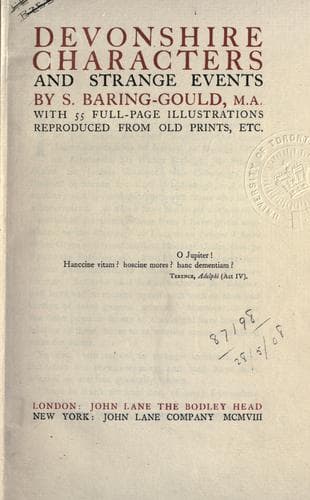
Devonshire Characters and Strange EventsBaring-Gould, S. (Sabine)
History
Devonshire Characters and Strange Events
Baring-Gould, S. (Sabine)
Devon (England) -- Biography; Devon (England) -- History
In personal appearance he was not striking. George Ticknor, in his
_Life, Letters, and Journals_, says, under 19 June, 1814: “Among other
persons I brought letters to Gifford, the satirist, but never saw him
till yesterday. Never was I so mistaken in my anticipations. Instead of
a tall and handsome man, as I had supposed him from his pictures, a man
of severe and bitter remarks in conversation, such as I had good reason
to believe him from his books, I found him a short, deformed, and ugly
little man, with a large head sunk between his shoulders, and one of
his eyes turned outward, but withal one of the best-natured, most open,
and well-bred gentlemen I have met.”
From the ability and keenness of the _Baviad_ and _Mæviad_, and from
a promise made in his edition of the latter to continue his satirical
writings, it was hoped that he would do this, but he did not. Byron
says:--
“Why slumbers Gifford?” once was asked in vain.
Why slumbers Gifford? let us ask again.
Are there no follies for his pen to purge?
Are there no fools whose backs demand the scourge?
Are there no sins for satire’s bard to greet?
Stalks not gigantic Vice in every street?
Shall peers or princes tread pollution’s path
And ’scape alike the law’s and Muse’s wrath?
Nor blaze with guilty stare through future time,
Eternal beacons of consummate crime?
Arouse thee, Gifford! be thy promise claim’d,
Make bad men better, or, at least, ashamed.
One curious peculiarity Gifford had. He made his old housekeeper sit in
his study doing her needlework whilst he was engaged on his literary
labours. To the end he maintained a warm friendship with Dr. Ireland,
Dean of Westminster, son of a butcher of Ashburton, and a schoolfellow
in former days, and when he died he bequeathed to him his library.
“The last month of Gifford’s life was but a slow dying”, says Mr.
Smiles. “He was sleepless, feverish, oppressed by an extreme difficulty
of breathing, which often deprived him of speech; and his sight had
failed. Towards the end of his life he would sometimes take up a pen,
and after a vain attempt to write, would throw it down, saying, ‘No,
my work is done.’ Even thinking caused him pain. As his last hour drew
near, his mind began to wander. ‘These books have driven me mad,’ he
once said; ‘I must read my prayers.’ He passed gradually away, his
pulse ceasing to beat five hours before his death. And then he slept
out of life on the 31st December, 1826, in his 71st year.”
He left £25,000 of personal property. He left the bulk of it to the
Rev. John Cookesley, son of his early patron, whom he also instituted
residuary legatee. He also left a sum of money the interest of which
was to be distributed annually among the poor of Ashburton.
Public-domain text, read in full here on John Shaqi.
Reviews
Reviews
No reviews yet
Be the first to share your thoughts on this work.
Elsewhere in the archive
Join the Discussion
Join the discussion
Sign in to leave a comment or review.
Sign InorCreate an account