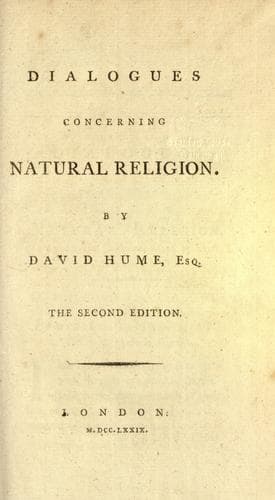
Natural theology -- Early works to 1800; Religion -- Early works to 1800
It sometimes happens, I own, that the religious arguments have not their
due influence on an ignorant savage and barbarian; not because they are
obscure and difficult, but because he never asks himself any question
with regard to them. Whence arises the curious structure of an animal?
From the copulation of its parents. And these whence? From their parents?
A few removes set the objects at such a distance, that to him they are
lost in darkness and confusion; nor is he actuated by any curiosity to
trace them further. But this is neither dogmatism nor scepticism, but
stupidity: a state of mind very different from your sifting, inquisitive
disposition, my ingenious friend. You can trace causes from effects: You
can compare the most distant and remote objects: and your greatest errors
proceed not from barrenness of thought and invention, but from too
luxuriant a fertility, which suppresses your natural good sense, by a
profusion of unnecessary scruples and objections.
Here I could observe, HERMIPPUS, that PHILO was a little embarrassed and
confounded: But while he hesitated in delivering an answer, luckily for
him, DEMEA broke in upon the discourse, and saved his countenance.
Your instance, CLEANTHES, said he, drawn from books and language, being
familiar, has, I confess, so much more force on that account: but is
there not some danger too in this very circumstance; and may it not
render us presumptuous, by making us imagine we comprehend the Deity, and
have some adequate idea of his nature and attributes? When I read a
volume, I enter into the mind and intention of the author: I become him,
in a manner, for the instant; and have an immediate feeling and
conception of those ideas which revolved in his imagination while
employed in that composition. But so near an approach we never surely can
make to the Deity. His ways are not our ways. His attributes are perfect,
but incomprehensible. And this volume of nature contains a great and
inexplicable riddle, more than any intelligible discourse or reasoning.
The ancient PLATONISTS, you know, were the most religious and devout of
all the Pagan philosophers; yet many of them, particularly PLOTINUS,
expressly declare, that intellect or understanding is not to be ascribed
to the Deity; and that our most perfect worship of him consists, not in
acts of veneration, reverence, gratitude, or love; but in a certain
mysterious self-annihilation, or total extinction of all our faculties.
These ideas are, perhaps, too far stretched; but still it must be
acknowledged, that, by representing the Deity as so intelligible and
comprehensible, and so similar to a human mind, we are guilty of the
grossest and most narrow partiality, and make ourselves the model of the
whole universe.
Public-domain text, read in full here on John Shaqi.
Reviews
Reviews
No reviews yet
Be the first to share your thoughts on this work.
Join the Discussion
Join the discussion
Sign in to leave a comment or review.
Sign InorCreate an account