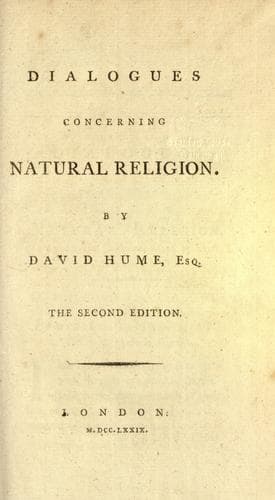
Natural theology -- Early works to 1800; Religion -- Early works to 1800
All the sentiments of the human mind, gratitude, resentment, love,
friendship, approbation, blame, pity, emulation, envy, have a plain
reference to the state and situation of man, and are calculated for
preserving the existence and promoting the activity of such a being in
such circumstances. It seems, therefore, unreasonable to transfer such
sentiments to a supreme existence, or to suppose him actuated by them;
and the phenomena besides of the universe will not support us in such a
theory. All our ideas, derived from the senses, are confessedly false and
illusive; and cannot therefore be supposed to have place in a supreme
intelligence: And as the ideas of internal sentiment, added to those of
the external senses, compose the whole furniture of human understanding,
we may conclude, that none of the materials of thought are in any respect
similar in the human and in the divine intelligence. Now, as to the
manner of thinking; how can we make any comparison between them, or
suppose them any wise resembling? Our thought is fluctuating, uncertain,
fleeting, successive, and compounded; and were we to remove these
circumstances, we absolutely annihilate its essence, and it would in such
a case be an abuse of terms to apply to it the name of thought or reason.
At least if it appear more pious and respectful (as it really is) still
to retain these terms, when we mention the Supreme Being, we ought to
acknowledge, that their meaning, in that case, is totally
incomprehensible; and that the infirmities of our nature do not permit us
to reach any ideas which in the least correspond to the ineffable
sublimity of the Divine attributes.
PART 4
It seems strange to me, said CLEANTHES, that you, DEMEA, who are so
sincere in the cause of religion, should still maintain the mysterious,
incomprehensible nature of the Deity, and should insist so strenuously
that he has no manner of likeness or resemblance to human creatures. The
Deity, I can readily allow, possesses many powers and attributes of which
we can have no comprehension: But if our ideas, so far as they go, be not
just, and adequate, and correspondent to his real nature, I know not what
there is in this subject worth insisting on. Is the name, without any
meaning, of such mighty importance? Or how do you mystics, who maintain
the absolute incomprehensibility of the Deity, differ from Sceptics or
Atheists, who assert, that the first cause of all is unknown and
unintelligible? Their temerity must be very great, if, after rejecting
the production by a mind, I mean a mind resembling the human, (for I know
of no other,) they pretend to assign, with certainty, any other specific
intelligible cause: And their conscience must be very scrupulous indeed,
if they refuse to call the universal unknown cause a God or Deity; and to
bestow on him as many sublime eulogies and unmeaning epithets as you
shall please to require of them.
Public-domain text, read in full here on John Shaqi.
Reviews
Reviews
No reviews yet
Be the first to share your thoughts on this work.
Join the Discussion
Join the discussion
Sign in to leave a comment or review.
Sign InorCreate an account