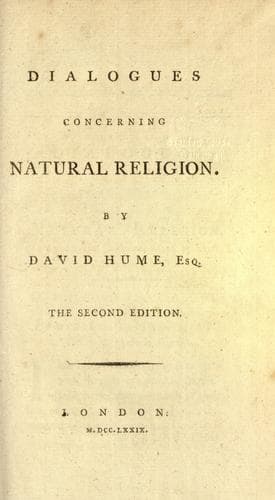
Natural theology -- Early works to 1800; Religion -- Early works to 1800
Again, when we will needs force Experience to pronounce some sentence,
even on these subjects which lie beyond her sphere, neither can she
perceive any material difference in this particular, between these two
kinds of worlds; but finds them to be governed by similar principles, and
to depend upon an equal variety of causes in their operations. We have
specimens in miniature of both of them. Our own mind resembles the one; a
vegetable or animal body the other. Let experience, therefore, judge from
these samples. Nothing seems more delicate, with regard to its causes,
than thought; and as these causes never operate in two persons after the
same manner, so we never find two persons who think exactly alike. Nor
indeed does the same person think exactly alike at any two different
periods of time. A difference of age, of the disposition of his body, of
weather, of food, of company, of books, of passions; any of these
particulars, or others more minute, are sufficient to alter the curious
machinery of thought, and communicate to it very different movements and
operations. As far as we can judge, vegetables and animal bodies are not
more delicate in their motions, nor depend upon a greater variety or more
curious adjustment of springs and principles.
How, therefore, shall we satisfy ourselves concerning the cause of that
Being whom you suppose the Author of Nature, or, according to your system
of Anthropomorphism, the ideal world, into which you trace the material?
Have we not the same reason to trace that ideal world into another ideal
world, or new intelligent principle? But if we stop, and go no further;
why go so far? why not stop at the material world? How can we satisfy
ourselves without going on in infinitum? And, after all, what
satisfaction is there in that infinite progression? Let us remember the
story of the Indian philosopher and his elephant. It was never more
applicable than to the present subject. If the material world rests upon
a similar ideal world, this ideal world must rest upon some other; and so
on, without end. It were better, therefore, never to look beyond the
present material world. By supposing it to contain the principle of its
order within itself, we really assert it to be God; and the sooner we
arrive at that Divine Being, so much the better. When you go one step
beyond the mundane system, you only excite an inquisitive humour which it
is impossible ever to satisfy.
To say, that the different ideas which compose the reason of the Supreme
Being, fall into order of themselves, and by their own nature, is really
to talk without any precise meaning. If it has a meaning, I would fain
know, why it is not as good sense to say, that the parts of the material
world fall into order of themselves and by their own nature. Can the one
opinion be intelligible, while the other is not so?
Public-domain text, read in full here on John Shaqi.
Reviews
Reviews
No reviews yet
Be the first to share your thoughts on this work.
Join the Discussion
Join the discussion
Sign in to leave a comment or review.
Sign InorCreate an account