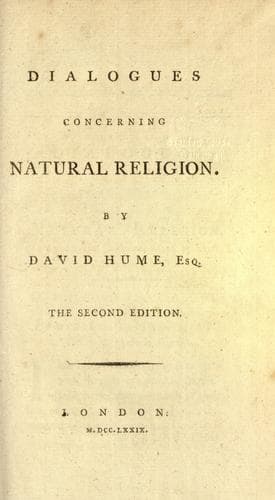
Natural theology -- Early works to 1800; Religion -- Early works to 1800
We have, indeed, experience of ideas which fall into order of themselves,
and without any known cause. But, I am sure, we have a much larger
experience of matter which does the same; as, in all instances of
generation and vegetation, where the accurate analysis of the cause
exceeds all human comprehension. We have also experience of particular
systems of thought and of matter which have no order; of the first in
madness, of the second in corruption. Why, then, should we think, that
order is more essential to one than the other? And if it requires a cause
in both, what do we gain by your system, in tracing the universe of
objects into a similar universe of ideas? The first step which we make
leads us on for ever. It were, therefore, wise in us to limit all our
inquiries to the present world, without looking further. No satisfaction
can ever be attained by these speculations, which so far exceed the
narrow bounds of human understanding.
It was usual with the PERIPATETICS, you know, CLEANTHES, when the cause
of any phenomenon was demanded, to have recourse to their faculties or
occult qualities; and to say, for instance, that bread nourished by its
nutritive faculty, and senna purged by its purgative. But it has been
discovered, that this subterfuge was nothing but the disguise of
ignorance; and that these philosophers, though less ingenuous, really
said the same thing with the sceptics or the vulgar, who fairly confessed
that they knew not the cause of these phenomena. In like manner, when it
is asked, what cause produces order in the ideas of the Supreme Being;
can any other reason be assigned by you, Anthropomorphites, than that it
is a rational faculty, and that such is the nature of the Deity? But why
a similar answer will not be equally satisfactory in accounting for the
order of the world, without having recourse to any such intelligent
creator as you insist on, may be difficult to determine. It is only to
say, that such is the nature of material objects, and that they are all
originally possessed of a faculty of order and proportion. These are only
more learned and elaborate ways of confessing our ignorance; nor has the
one hypothesis any real advantage above the other, except in its greater
conformity to vulgar prejudices.
Public-domain text, read in full here on John Shaqi.
Reviews
Reviews
No reviews yet
Be the first to share your thoughts on this work.
Join the Discussion
Join the discussion
Sign in to leave a comment or review.
Sign InorCreate an account