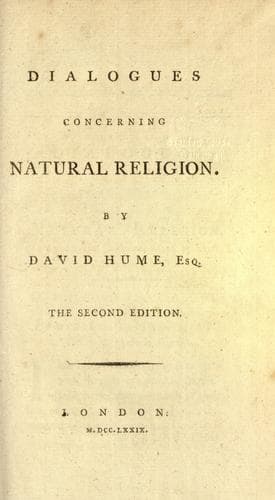
Natural theology -- Early works to 1800; Religion -- Early works to 1800
You have displayed this argument with great emphasis, replied CLEANTHES:
You seem not sensible how easy it is to answer it. Even in common life,
if I assign a cause for any event, is it any objection, PHILO, that I
cannot assign the cause of that cause, and answer every new question
which may incessantly be started? And what philosophers could possibly
submit to so rigid a rule? philosophers, who confess ultimate causes to
be totally unknown; and are sensible, that the most refined principles
into which they trace the phenomena, are still to them as inexplicable as
these phenomena themselves are to the vulgar. The order and arrangement
of nature, the curious adjustment of final causes, the plain use and
intention of every part and organ; all these bespeak in the clearest
language an intelligent cause or author. The heavens and the earth join
in the same testimony: The whole chorus of Nature raises one hymn to the
praises of its Creator. You alone, or almost alone, disturb this general
harmony. You start abstruse doubts, cavils, and objections: You ask me,
what is the cause of this cause? I know not; I care not; that concerns
not me. I have found a Deity; and here I stop my inquiry. Let those go
further, who are wiser or more enterprising.
I pretend to be neither, replied PHILO: And for that very reason, I
should never perhaps have attempted to go so far; especially when I am
sensible, that I must at last be contented to sit down with the same
answer, which, without further trouble, might have satisfied me from the
beginning. If I am still to remain in utter ignorance of causes, and can
absolutely give an explication of nothing, I shall never esteem it any
advantage to shove off for a moment a difficulty, which, you acknowledge,
must immediately, in its full force, recur upon me. Naturalists indeed
very justly explain particular effects by more general causes, though
these general causes themselves should remain in the end totally
inexplicable; but they never surely thought it satisfactory to explain a
particular effect by a particular cause, which was no more to be
accounted for than the effect itself. An ideal system, arranged of
itself, without a precedent design, is not a whit more explicable than a
material one, which attains its order in a like manner; nor is there any
more difficulty in the latter supposition than in the former.
PART 5
But to show you still more inconveniences, continued PHILO, in your
Anthropomorphism, please to take a new survey of your principles. Like
effects prove like causes. This is the experimental argument; and this,
you say too, is the sole theological argument. Now, it is certain, that
the liker the effects are which are seen, and the liker the causes which
are inferred, the stronger is the argument. Every departure on either
side diminishes the probability, and renders the experiment less
conclusive. You cannot doubt of the principle; neither ought you to
reject its consequences.
Public-domain text, read in full here on John Shaqi.
Reviews
Reviews
No reviews yet
Be the first to share your thoughts on this work.
Join the Discussion
Join the discussion
Sign in to leave a comment or review.
Sign InorCreate an account