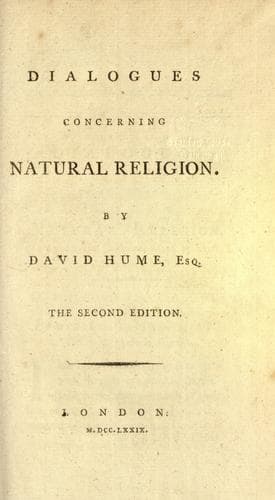
Natural theology -- Early works to 1800; Religion -- Early works to 1800
But, in the next place, your theory seems to imply the eternity of the
world; and that is a principle, which, I think, can be refuted by the
strongest reasons and probabilities. I shall suggest an argument to this
purpose, which, I believe, has not been insisted on by any writer. Those,
who reason from the late origin of arts and sciences, though their
inference wants not force, may perhaps be refuted by considerations
derived from the nature of human society, which is in continual
revolution, between ignorance and knowledge, liberty and slavery, riches
and poverty; so that it is impossible for us, from our limited
experience, to foretell with assurance what events may or may not be
expected. Ancient learning and history seem to have been in great danger
of entirely perishing after the inundation of the barbarous nations; and
had these convulsions continued a little longer, or been a little more
violent, we should not probably have now known what passed in the world a
few centuries before us. Nay, were it not for the superstition of the
Popes, who preserved a little jargon of Latin, in order to support the
appearance of an ancient and universal church, that tongue must have been
utterly lost; in which case, the Western world, being totally barbarous,
would not have been in a fit disposition for receiving the GREEK language
and learning, which was conveyed to them after the sacking of
CONSTANTINOPLE. When learning and books had been extinguished, even the
mechanical arts would have fallen considerably to decay; and it is easily
imagined, that fable or tradition might ascribe to them a much later
origin than the true one. This vulgar argument, therefore, against the
eternity of the world, seems a little precarious.
But here appears to be the foundation of a better argument. LUCULLUS was
the first that brought cherry-trees from ASIA to EUROPE; though that tree
thrives so well in many EUROPEAN climates, that it grows in the woods
without any culture. Is it possible, that throughout a whole eternity, no
EUROPEAN had ever passed into ASIA, and thought of transplanting so
delicious a fruit into his own country? Or if the tree was once
transplanted and propagated, how could it ever afterwards perish? Empires
may rise and fall, liberty and slavery succeed alternately, ignorance and
knowledge give place to each other; but the cherry-tree will still remain
in the woods of GREECE, SPAIN, and ITALY, and will never be affected by
the revolutions of human society.
Public-domain text, read in full here on John Shaqi.
Reviews
Reviews
No reviews yet
Be the first to share your thoughts on this work.
Join the Discussion
Join the discussion
Sign in to leave a comment or review.
Sign InorCreate an account