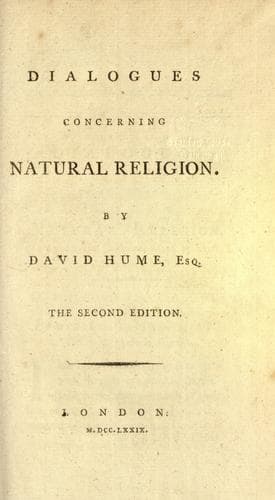
Natural theology -- Early works to 1800; Religion -- Early works to 1800
It is not two thousand years since vines were transplanted into FRANCE,
though there is no climate in the world more favourable to them. It is
not three centuries since horses, cows, sheep, swine, dogs, corn, were
known in AMERICA. Is it possible, that during the revolutions of a whole
eternity, there never arose a COLUMBUS, who might open the communication
between EUROPE and that continent? We may as well imagine, that all men
would wear stockings for ten thousand years, and never have the sense to
think of garters to tie them. All these seem convincing proofs of the
youth, or rather infancy, of the world; as being founded on the operation
of principles more constant and steady than those by which human society
is governed and directed. Nothing less than a total convulsion of the
elements will ever destroy all the EUROPEAN animals and vegetables which
are now to be found in the Western world.
And what argument have you against such convulsions? replied PHILO.
Strong and almost incontestable proofs may be traced over the whole
earth, that every part of this globe has continued for many ages entirely
covered with water. And though order were supposed inseparable from
matter, and inherent in it; yet may matter be susceptible of many and
great revolutions, through the endless periods of eternal duration. The
incessant changes, to which every part of it is subject, seem to intimate
some such general transformations; though, at the same time, it is
observable, that all the changes and corruptions of which we have ever
had experience, are but passages from one state of order to another; nor
can matter ever rest in total deformity and confusion. What we see in the
parts, we may infer in the whole; at least, that is the method of
reasoning on which you rest your whole theory. And were I obliged to
defend any particular system of this nature, which I never willingly
should do, I esteem none more plausible than that which ascribes an
eternal inherent principle of order to the world, though attended with
great and continual revolutions and alterations. This at once solves all
difficulties; and if the solution, by being so general, is not entirely
complete and satisfactory, it is at least a theory that we must sooner or
later have recourse to, whatever system we embrace. How could things have
been as they are, were there not an original inherent principle of order
somewhere, in thought or in matter? And it is very indifferent to which
of these we give the preference. Chance has no place, on any hypothesis,
sceptical or religious. Every thing is surely governed by steady,
inviolable laws. And were the inmost essence of things laid open to us,
we should then discover a scene, of which, at present, we can have no
idea. Instead of admiring the order of natural beings, we should clearly
see that it was absolutely impossible for them, in the smallest article,
ever to admit of any other disposition.
Public-domain text, read in full here on John Shaqi.
Reviews
Reviews
No reviews yet
Be the first to share your thoughts on this work.
Join the Discussion
Join the discussion
Sign in to leave a comment or review.
Sign InorCreate an account