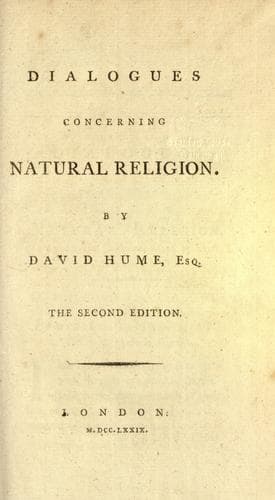
Dialogues Concerning Natural Religion — John Shaqi
Dialogues Concerning Natural ReligionHume, David
ReligionComparative
Dialogues Concerning Natural Religion
Hume, David
Natural theology -- Early works to 1800; Religion -- Early works to 1800
It is pretended that the Deity is a necessarily existent being; and this
necessity of his existence is attempted to be explained by asserting,
that if we knew his whole essence or nature, we should perceive it to be
as impossible for him not to exist, as for twice two not to be four. But
it is evident that this can never happen, while our faculties remain the
same as at present. It will still be possible for us, at any time, to
conceive the non-existence of what we formerly conceived to exist; nor
can the mind ever lie under a necessity of supposing any object to remain
always in being; in the same manner as we lie under a necessity of always
conceiving twice two to be four. The words, therefore, necessary
existence, have no meaning; or, which is the same thing, none that is
consistent.
But further, why may not the material universe be the necessarily
existent Being, according to this pretended explication of necessity? We
dare not affirm that we know all the qualities of matter; and for aught
we can determine, it may contain some qualities, which, were they known,
would make its non-existence appear as great a contradiction as that
twice two is five. I find only one argument employed to prove, that the
material world is not the necessarily existent Being: and this argument
is derived from the contingency both of the matter and the form of the
world. "Any particle of matter," it is said[]Dr. Clarke, "may be conceived
to be annihilated; and any form may be conceived to be altered. Such an
annihilation or alteration, therefore, is not impossible." But it seems
a great partiality not to perceive, that the same argument extends
equally to the Deity, so far as we have any conception of him; and that
the mind can at least imagine him to be non-existent, or his attributes
to be altered. It must be some unknown, inconceivable qualities, which
can make his non-existence appear impossible, or his attributes
unalterable: And no reason can be assigned, why these qualities may not
belong to matter. As they are altogether unknown and inconceivable, they
can never be proved incompatible with it.
Add to this, that in tracing an eternal succession of objects, it seems
absurd to inquire for a general cause or first author. How can any thing,
that exists from eternity, have a cause, since that relation implies a
priority in time, and a beginning of existence?
Public-domain text, read in full here on John Shaqi.
Reviews
Reviews
No reviews yet
Be the first to share your thoughts on this work.
Join the Discussion
Join the discussion
Sign in to leave a comment or review.
Sign InorCreate an account