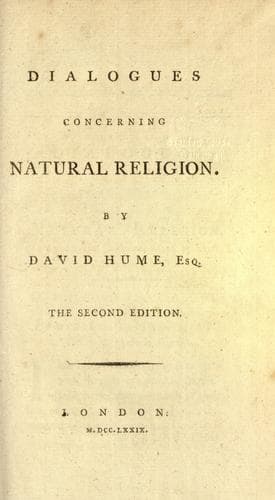
Natural theology -- Early works to 1800; Religion -- Early works to 1800
In such a chain, too, or succession of objects, each part is caused by
that which preceded it, and causes that which succeeds it. Where then is
the difficulty? But the whole, you say, wants a cause. I answer, that the
uniting of these parts into a whole, like the uniting of several distinct
countries into one kingdom, or several distinct members into one body, is
performed merely by an arbitrary act of the mind, and has no influence on
the nature of things. Did I show you the particular causes of each
individual in a collection of twenty particles of matter, I should think
it very unreasonable, should you afterwards ask me, what was the cause of
the whole twenty. This is sufficiently explained in explaining the cause
of the parts.
Though the reasonings which you have urged, CLEANTHES, may well excuse
me, said PHILO, from starting any further difficulties, yet I cannot
forbear insisting still upon another topic. It is observed by
arithmeticians, that the products of 9, compose always either 9, or some
lesser product of 9, if you add together all the characters of which any
of the former products is composed. Thus, of 18, 27, 36, which are
products of 9, you make 9 by adding 1 to 8, 2 to 7, 3 to 6. Thus, 369 is
a product also of 9; and if you add 3, 6, and 9, you make 18, a lesser
product of 9. To a superficial observer, so wonderful a regularity may
be admired as the effect either of chance or design: but a skilful
algebraist immediately concludes it to be the work of necessity, and
demonstrates, that it must for ever result from the nature of these
numbers. Is it not probable, I ask, that the whole economy of the
universe is conducted by a like necessity, though no human algebra can
furnish a key which solves the difficulty? And instead of admiring the
order of natural beings, may it not happen, that, could we penetrate into
the intimate nature of bodies, we should clearly see why it was
absolutely impossible they could ever admit of any other disposition? So
dangerous is it to introduce this idea of necessity into the present
question! and so naturally does it afford an inference directly opposite
to the religious hypothesis!
Public-domain text, read in full here on John Shaqi.
Reviews
Reviews
No reviews yet
Be the first to share your thoughts on this work.
Join the Discussion
Join the discussion
Sign in to leave a comment or review.
Sign InorCreate an account