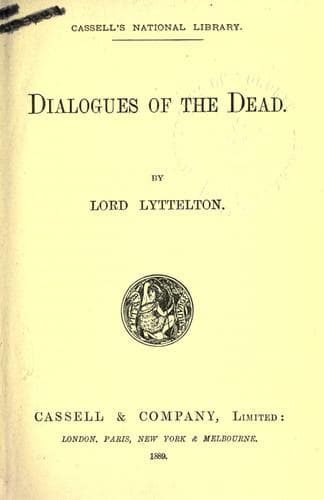
Dialogues of the DeadLyttelton, George Lyttelton, Baron
Philosophy
Dialogues of the Dead
Lyttelton, George Lyttelton, Baron
Dialogues, English -- Early works to 1800; Imaginary conversations
_Scipio_.--Give me thy hand, noble Titus. Thou wast worthy of the
empire, and Scipio Africanus honours thy virtue.
_Titus_.--My virtue can have no greater reward from the approbation of
man. But, O Scipio, think what anguish my heart must have felt when I
took that resolution, and when I communicated it to my dear, my unhappy
Berenice. You saw the struggle of Masinissa, when you forced him to give
up his beloved Sophonisba. Mine was a harder conflict. She had
abandoned him to marry the King of Numidia. He knew that her ruling
passion was ambition, not love. He could not rationally esteem her when
she quitted a husband whom she had ruined, who had lost his crown and his
liberty in the cause of her country and for her sake, to give her person
to him, the capital foe of that unfortunate husband. He must, in spite
of his passion, have thought her a perfidious, a detestable woman. But I
esteemed Berenice; she deserved my esteem. I was certain she would not
have accepted the empire from any other hand; and had I been a private
man she would have raised me to her throne. Yet I had the fortitude--I
ought, perhaps, to say the hardness of heart--to bid her depart from my
sight; depart for ever! What, O Publius, was your conquest over
yourself, in giving back to her betrothed lover the Celtiberian captive
compared to this? Indeed, that was no conquest. I will not so dishonour
the virtue of Scipio as to think he could feel any struggle with himself
on that account. A woman engaged to another--engaged by affection as
well as vows, let her have been ever so beautiful--could raise in your
heart no sentiments but compassion and friendship. To have violated her
would have been an act of brutality, which none but another Tarquin could
have committed. To have detained her from her husband would have been
cruel. But where love is mutual, where the object beloved suffers more
in the separation than you do yourself, to part with her is indeed a
struggle. It is the hardest sacrifice a good heart can make to its duty.
_Scipio_.--I acknowledge that it is, and yield you the palm. But I will
own to you, Titus, I never knew much of the tenderness you describe.
Hannibal, Carthage, Rome, the saving of my country, the subduing of its
rival, these filled my thoughts, and left no room there for those
effeminate passions. I do not blame your sensibility; but when I went to
the capitol to talk with Jove, I never consulted him about love affairs.
_Titus_.--If my soul had been possessed by ambition alone, I might
possibly have been a greater man than I was; but I should not have been
more virtuous, nor have gained the title I preferred to that of conqueror
of Judaea and Emperor of Rome, in being called the delight of humankind.
DIALOGUE XII
HENRY DUKE OF GUISE--MACHIAVEL.
Public-domain text, read in full here on John Shaqi.
Reviews
Reviews
No reviews yet
Be the first to share your thoughts on this work.
Join the Discussion
Join the discussion
Sign in to leave a comment or review.
Sign InorCreate an account